
Oviond Blog
Best Client Portal Software: Top 10 for Agencies in 2026
Find the best client portal software for marketing agencies in 2026. Compare 10 top options: features, pricing, & white-label reporting. Boost efficiency!

You're probably here because your current “client portal” isn't solving the job your agency needs done. Clients still ask for updates in email. Account managers still chase screenshots from GA4, ad platforms, and CRM tools. Reports still get rebuilt every month. And even when you have a portal, it often acts more like a file cabinet than a place clients want to visit.
That's the big split most roundups miss. Some tools are true client portals for documents, billing, approvals, and messaging. Others are agency-native reporting portals built to deliver branded dashboards, automated delivery, and multi-client performance visibility. For agencies managing recurring reporting across 5 to 50+ clients, that difference matters a lot more than feature checklists.
The broader client portal category is growing fast. The market was valued at USD 1.76 billion in 2023 and is projected to reach USD 7.95 billion by 2032, with North America holding the largest share at USD 1.12 billion in 2024, according to SNS Insider's client portal software market analysis. That growth makes sense. Agencies are moving away from scattered email threads and static PDFs toward branded, secure client environments.
If you want a wider view of the category, CasePulse client portal solutions is a useful companion read. This list focuses on what works for agencies. Agency reporting that finally feels simple.
Table of Contents
- 1. Oviond
- 2. Copilot
- 3. SuiteDash
- 4. ManyRequests
- 5. Service Provider Pro SPP / Wayfront
- 6. Zendo
- 7. Moxo
- 8. Clinked
- 9. Ahsuite
- 10. CloudRadial
- Top 10 Client Portal Software Comparison
- Final Thoughts
1. Oviond
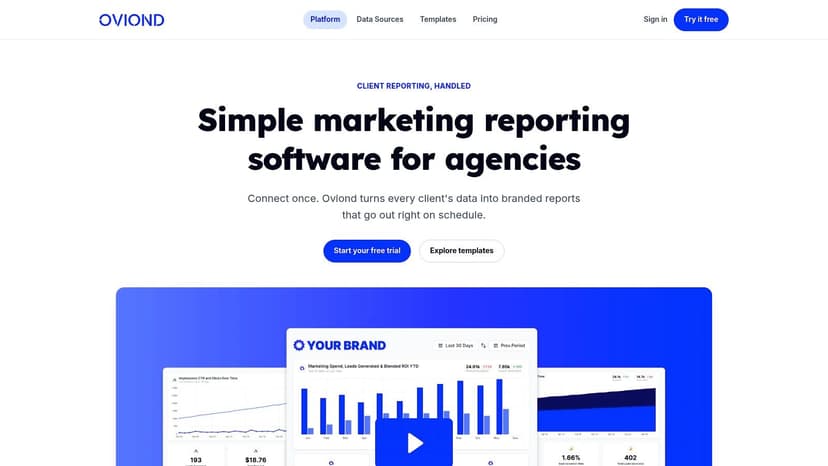
Monday morning usually tells you what kind of portal your agency needs. If clients are asking where the latest numbers live, account managers are exporting screenshots from three tools, and reporting still depends on whoever knows the spreadsheet logic, a general client portal will not fix the bottleneck. Oviond is built for the reporting side of client delivery. It gives agencies a white-label place to present performance data, automate recurring reports, and keep dashboards consistent across accounts.
That puts it in a different category from tools built around files, tasks, approvals, or messaging. Agencies often group all of that under “client portal software,” but the actual job-to-be-done is narrower for many marketing teams. They need a branded reporting layer clients will use, and a system the delivery team can maintain without rebuilding every report from scratch.
GetApp's Oviond profile highlights the platform's broad connector coverage. The practical advantage is simple. Your team can pull analytics, paid media, SEO, social, email, CRM, and ecommerce metrics into one workflow instead of stitching together updates client by client.
Why Oviond fits agency reporting work
Oviond feels agency-native because the reporting workflow is the product, not an add-on. You get a drag-and-drop builder, reusable widgets, templates, calculated metrics, goals, scheduling, and white-label delivery with custom domains and custom email senders. It also includes unlimited dashboards, unlimited reports, and unlimited team users, which matters once reporting touches account managers, strategists, and leadership.
Pricing is also easier to model than many portal tools. Plans are based on client count rather than stacking seat fees, feature gates, and extra reporting modules. For an ops lead trying to standardize delivery across dozens of accounts, that makes budgeting and margin planning more predictable.
Practical rule: If the client experience depends on regular performance updates, start with a reporting portal. Add broader workflow tools later if you need them.
Oviond's MCP server also lets teams use a compatible external AI tool to help build dashboards from connected sources. It does not replace reporting strategy, but it can reduce the setup drag that slows down template standardization.
Teams tightening onboarding can also connect reporting setup to a documented client onboarding checklist for digital marketing agencies. That helps when the goal is to make dashboard access, KPI definitions, and data source connections part of day-one delivery rather than a cleanup task in month two.
Where it works best and where to watch it
Oviond works best when the portal itself is the reporting experience. Clients log in to see live branded dashboards, review scheduled reports, and stay inside your agency's presentation layer. That is a different use case from a general portal where reporting is embedded from somewhere else and treated as one more tab.
As noted on Oviond's dashboard and reporting software page, the platform is designed around agency presentation and white-label delivery. That matters because reporting adoption usually drops when clients have to bounce between PDFs, shared links, and third-party dashboards that feel disconnected from your service.
The trade-offs are real. Some teams report occasional connector issues and periodic source reconnects. Setup also rewards process discipline. If your agency has never standardized KPIs, naming conventions, or report templates, the tool will expose that quickly.
If your portal needs to center on contracts, billing, intake forms, and support requests, another platform may fit better. If the primary difficulty is scaling multi-client reporting without chaos, Oviond belongs at the top of the shortlist.
- Best for: Agencies that need white-label client reporting, branded dashboards, custom domain delivery, and automated recurring reports.
- Watch for: Some integrations need monitoring, and first-time setup takes planning if you are rolling out many client templates at once.
- Website: Oviond
2. Copilot
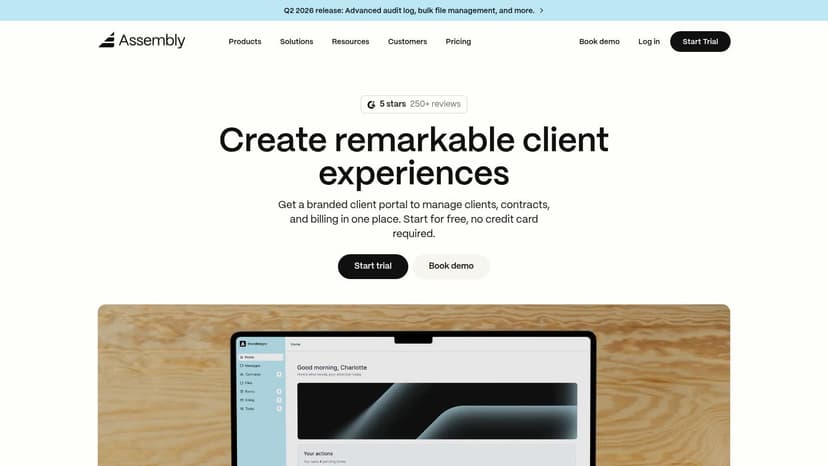
Copilot is a strong option when your agency wants a polished client-facing hub for messaging, files, forms, contracts, and payments. It feels more like a client operations portal than a reporting system. That distinction matters. If your main pain is communication and handoffs, Copilot makes more sense than a dashboard-first platform.
Its strength is consolidation. You can create branded spaces for clients, control access by role, and embed outside tools inside the client experience. That helps if you already use other apps for scheduling, docs, or dashboards and want one cleaner front door for clients.
What it does well
Copilot is useful for agencies that want the portal to carry more of the relationship. Clients can upload files, review documents, message your team, complete forms, and handle billing in one place. That cuts down on “which app do I use for this client?” confusion.
The trade-off is that it doesn't solve agency reporting in a native way. You can embed reports, but embedding is not the same as having a proper reporting layer with reusable templates, blended metrics, and automated client reporting built in.
Copilot is a better fit for agencies selling a service experience through the portal. It's a weaker fit for agencies trying to standardize multi-channel reporting across many accounts.
Pricing also isn't as transparent as some buyers would like, so you'll usually need a demo or sales conversation.
- Best for: Agencies that want a branded client workspace for communication, docs, forms, and payments.
- Watch for: Less ideal if the portal's main job is client reporting rather than client admin.
- Website: Copilot
3. SuiteDash
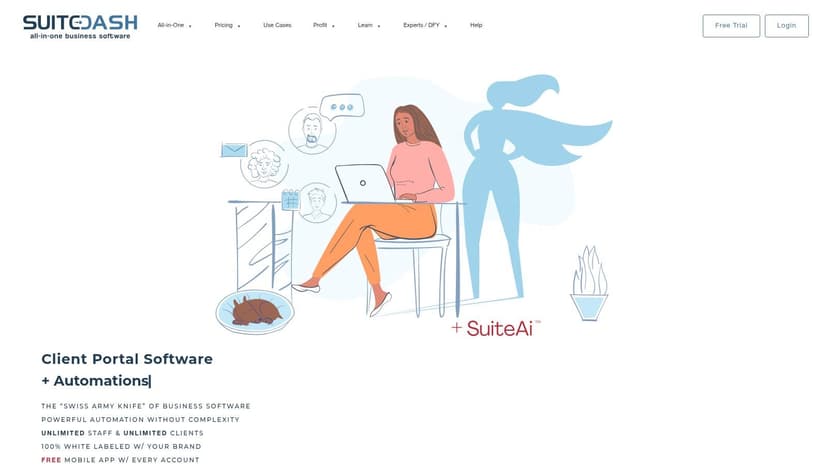
SuiteDash takes the “all-in-one” route seriously. It combines CRM, white-label portal, project management, proposals, invoicing, subscriptions, e-signatures, chat, and support-style workflows. For some agencies, that's appealing because one system can replace a pile of smaller tools.
This is not a lightweight product. SuiteDash asks you to buy into its way of running operations. If you do, it can become the central hub for clients and your team.
Why agencies choose it
The flat pricing model and unlimited clients and team members are attractive for agencies that hate per-seat cost creep. White-labeling is also deep, with custom domain support and branded mobile options. If your agency wants one branded environment for onboarding, proposals, billing, and project communication, SuiteDash gives you a lot under one roof.
The downside is setup complexity. Agencies that want something fast and obvious can get bogged down. The bigger the feature set, the more internal process decisions you need to make before it feels clean.
A practical way to think about it is this. SuiteDash is a business operating system with a portal attached. It's not an agency-native reporting portal. If you still need branded dashboards and automated performance reporting, you may end up pairing it with a reporting tool anyway.
- Best for: Agencies that want to consolidate CRM, billing, onboarding, and client access in one white-label system.
- Watch for: A steeper learning curve and more setup work than focused tools.
- Website: SuiteDash
4. ManyRequests
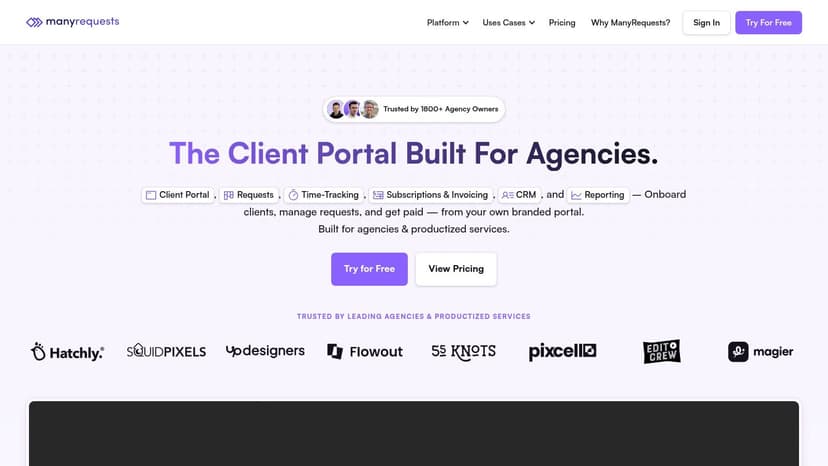
ManyRequests is built around request-based service delivery. If your agency runs productized offers, recurring creative work, content production, or design subscriptions, that focus shows up fast. The portal centers on intake, approvals, and billing rather than reporting depth.
That makes it useful for agencies where the client relationship revolves around submitting work, reviewing drafts, and paying for ongoing service packages. The workflow feels clearer than trying to force a generic portal into a ticket-plus-subscription model.
Best fit
The customizable forms and conditional logic help agencies structure incoming requests instead of letting everything arrive through Slack or email. Native Stripe billing also helps when you want subscriptions, one-off payments, or credits connected directly to the portal experience.
ManyRequests also lets you embed outside apps, which is handy if you already have dashboards elsewhere. Still, it has the same limitation as other general portals. Embedded reporting isn't the same as having agency-native client reporting built into the platform.
- Best for: Productized agencies and recurring service teams handling requests, approvals, and billing in one place.
- Watch for: Per-seat pricing can start to pinch as internal teams grow, and stronger white-label options may sit on higher tiers.
- Website: ManyRequests
5. Service Provider Pro SPP / Wayfront
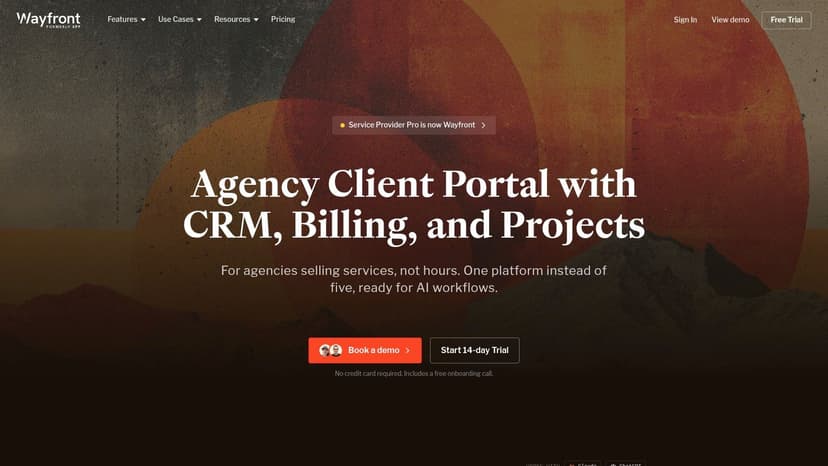
Service Provider Pro, also known as SPP and now Wayfront in some branding, is another portal with a strong service-commerce angle. It's built for agencies that sell structured services, capture orders, automate intake, and support clients through a branded portal.
That makes it especially relevant if your agency is moving toward packaged offers rather than custom retainers with loose scopes.
Where it stands out
SPP handles order forms, subscriptions, helpdesk-style support, and client messaging under a custom domain. It also emphasizes migration and onboarding help, which is valuable when an agency is replacing a patchwork setup and doesn't want a messy transition.
The big trade-off is focus. It's strong for agencies selling and fulfilling services. It's less compelling if your portal's main job is to present branded performance dashboards across channels. For that, you'd still want a separate reporting layer.
When a portal is built around selling services, it usually handles intake better than reporting. Agencies often underestimate that difference until month-end reporting still lives somewhere else.
Pricing isn't clearly laid out on the main site, so expect a sales-led buying process.
- Best for: Agencies productizing services and wanting intake, subscriptions, support, and branded client access together.
- Watch for: Narrower ecosystem than some broader platforms and less of a reporting-first fit.
- Website: Service Provider Pro
6. Zendo
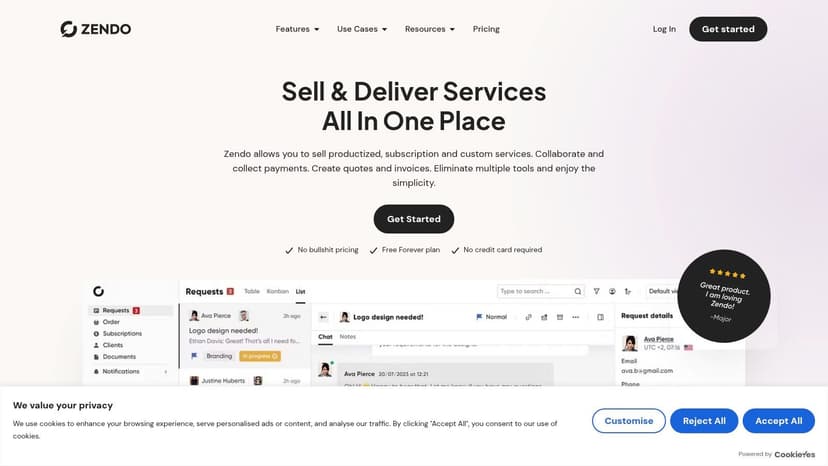
Zendo is a lighter-weight portal for agencies that want requests, messaging, files, and subscription-style service delivery without committing to a heavy all-in-one system. It's easier to trial than some bigger platforms, which makes it attractive for smaller teams cleaning up client comms.
The storefront angle is useful if you sell fixed packages or ongoing subscriptions and want clients to self-serve more of the buying process.
Who should consider it
Zendo works well for agencies that need a client-friendly front end but don't need enterprise complexity. Clients can interact through the portal or, in some cases, stay involved via email while records stay organized inside the system. That's practical when you're trying to improve operations without forcing every client into a new habit overnight.
It also supports embedding external apps, so you can surface docs, calendars, or design tools inside the portal. Still, if you need deep reporting, you're back to layering another product into the stack.
The missing piece for some teams is extensibility. If your agency depends on custom workflows or API-led connections, you'll want to check those limitations before committing.
- Best for: Small to mid-size agencies selling subscriptions or fixed-scope services through a clean portal.
- Watch for: Deeper white-label options and extensibility may require higher tiers or future roadmap features.
- Website: Zendo
7. Moxo
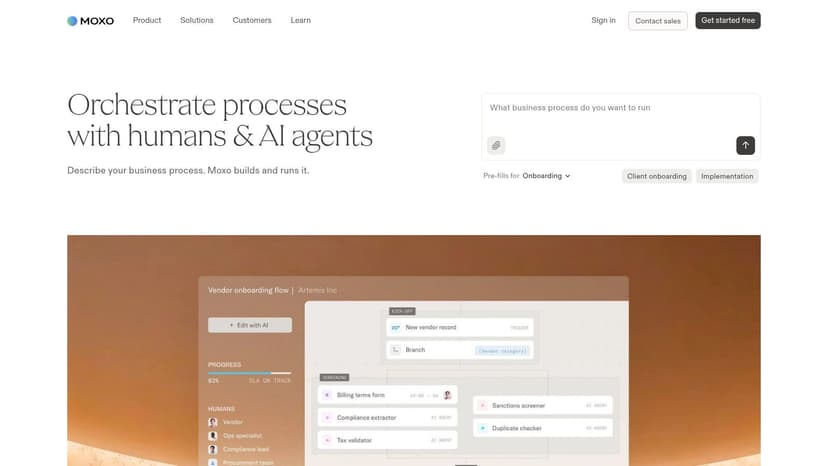
Moxo leans toward guided workflows, approvals, file requests, and secure client collaboration. It feels more process-heavy than most agency portals on this list. That can be a plus if your agency has formal onboarding, review, or compliance-sensitive workflows.
It's not built specifically for marketing agencies, but some agency teams will still like the structure.
Where it earns its keep
The workflow builder, milestones, approvals, e-signatures, and AI-assisted routing make Moxo a good fit for agencies that manage complex client steps and want tighter control over who does what next. If your operation includes regulated clients or high-touch onboarding, Moxo gives you more process muscle than a simple share-and-chat portal.
The trade-off is overhead. Teams that just need a clean place for branded dashboards, monthly updates, and a few client touchpoints may find it heavier than necessary. It solves process complexity better than it solves reporting complexity.
- Best for: Agencies with guided client workflows, approvals, and more structured collaboration needs.
- Watch for: More complexity than many agencies need for routine client reporting.
- Website: Moxo
8. Clinked
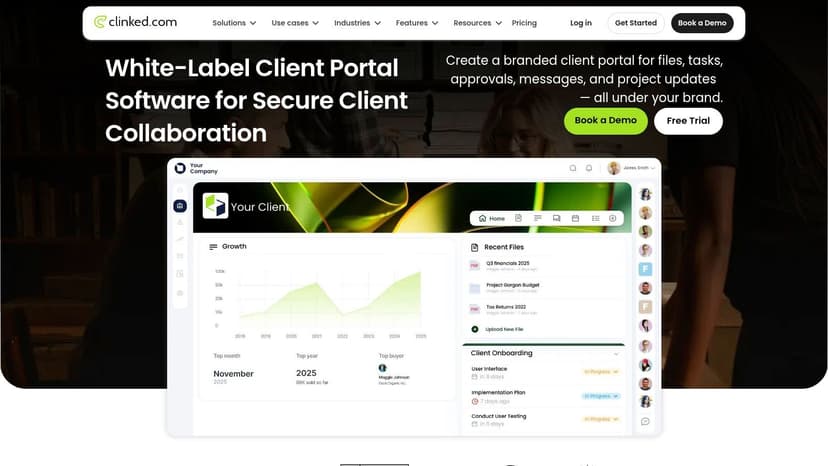
Clinked is one of the more established names in client portal software, especially for teams that care about security, granular permissions, and auditability. As of July 2026, the category has a verified base of 17,539 real-time user reviews across major platforms, and industry analysis identifies Clinked as a strong option for agencies, legal firms, and financial services that need secure white-label portals with advanced permissions and audit capabilities, according to G2's client portal category overview.
That positioning shows in the product. Clinked is less about flashy agency workflows and more about controlled collaboration.
Best use case
If your agency handles sensitive documents, detailed permissions, or client environments where audit trails matter, Clinked deserves a look. Native mobile apps also help when clients need access on the move, which not every portal handles well.
The trade-off is that Clinked is not a marketing reporting platform. It's a secure collaboration portal. Agencies that need branded dashboards, blended channel reporting, and automated client reporting will likely need another tool alongside it.
Security-heavy portals are great at governing access. They're usually less great at becoming the reporting hub an agency account team needs every week.
- Best for: Agencies with document-heavy, security-sensitive client collaboration requirements.
- Watch for: Less suited to reporting-led client delivery and pricing often requires a sales conversation.
- Website: Clinked
9. Ahsuite
Ahsuite is the lightweight option in this list. It gives agencies a simple portal for sharing files, tasks, messages, links, and embedded content with clients. If you want something your team can pilot quickly, Ahsuite is easy to understand.
That simplicity is the point. It doesn't try to be your CRM, billing suite, and workflow engine all at once.
Why teams pilot it first
Ahsuite works best when you already have reporting or project tools elsewhere and just need a neat client-facing layer to pull them together. The “embed anything” approach is useful for surfacing dashboards, documents, and external resources without a complex setup.
The trade-off is depth. You won't get the heavier automation, workflow controls, or advanced integrations of larger portal platforms. For many agencies, that's fine. For others, it means Ahsuite becomes a temporary stepping stone rather than the long-term system.
- Best for: Agencies that want a low-friction client portal for embeds, files, tasks, and basic communication.
- Watch for: Lighter workflow and automation features than more full-stack portal products.
- Website: Ahsuite
10. CloudRadial
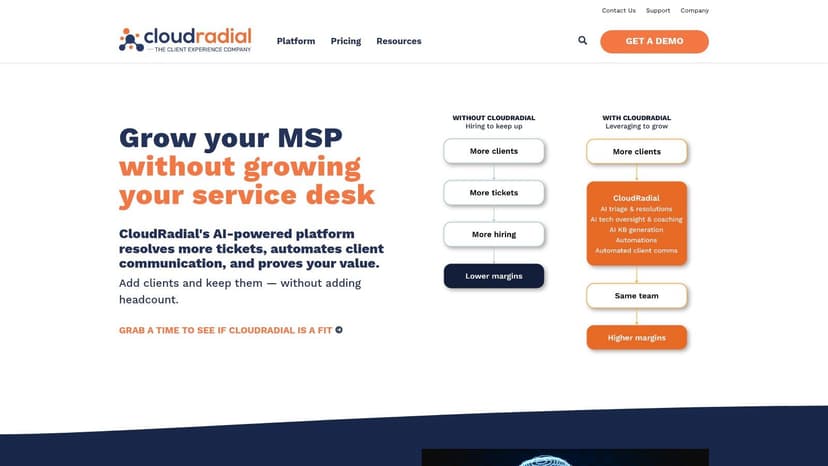
CloudRadial is a niche pick for this audience, but it belongs on the list because some agencies overlap with managed services or technical support. The platform is built for MSP and IT provider workflows, not mainstream marketing agency reporting.
That focus is both its strength and its limit.
Why it is niche
CloudRadial handles ticket intake, knowledge base access, service storefronts, planning workflows, and support automations tied to PSA and RMM systems. If your agency has an IT services arm, or if you support clients in a more technical retained-services model, it may line up well.
For a typical performance marketing agency, though, it's usually overkill. The workflows are oriented around service operations and support management, not branded dashboards and multi-channel client reporting. Balanced comparison matters here. It's a solid product in its lane. It's just a different lane.
- Best for: MSP-style agencies or technical service providers needing a unified client operations portal.
- Watch for: Too specialized for most marketing agencies focused on recurring reporting and campaign visibility.
- Website: CloudRadial
Top 10 Client Portal Software Comparison
| Product | Core Capabilities | Integrations & Data | Target Audience | Pricing & Value | Unique Selling Point |
|---|---|---|---|---|---|
| Oviond 🏆 | Branded live dashboards, drag‑drop builder, scheduled white‑label reports ✨ | 60+ sources (GA4, Ads, FB, Search Console, Shopify, Sheets) + Full API | 👥 Agencies & in‑house marketing teams | 💰 Single feature‑complete plan, scales by client; starts $39/mo (annual) | ✨ MCP-assisted report creation, unlimited dashboards/reports & team users |
| Copilot | Branded client portal: files, messaging, billing, contracts | Embeds external tools inside portals | 👥 Agencies, consultants, service firms | 💰 Pricing via sales / demo | ✨ Configurable modules + embedded app model |
| SuiteDash | All‑in‑one portal: CRM, proposals, e‑sign, invoicing, projects | Built‑in billing & workflows (fewer external needs) | 👥 Agencies wanting consolidated toolset | 💰 Flat pricing with unlimited clients/users | ✨ 100% white‑label + built‑in billing & mobile app |
| ManyRequests | Request/ticket portal with intake forms, proofing, approvals | Native Stripe billing (subscriptions, one‑offs, credits) | 👥 Agencies with productized/recurring services | 💰 Unlimited clients; clear tiers (seats/features vary) | ✨ Purpose‑built request flows + native billing |
| Service Provider Pro / Wayfront | White‑label storefront, orders, intake, helpdesk | Custom domain, payments, assisted migrations | 👥 Agencies selling productized services | 💰 Pricing via demo/quote | ✨ Hands‑on onboarding & referral tracking |
| Zendo | Client portal + storefront, requests, messaging, subscriptions | Embeds (Figma, Docs, Calendly); API coming soon | 👥 Small–mid agencies selling packages | 💰 Tiered pricing with free Essential plan | ✨ Email‑only client participation; clear free trial path |
| Moxo | Branded portal with workflow builder, e‑sign, approvals | Enterprise security, AI “agents” for flows | 👥 Regulated/high‑touch industries (finance, legal) | 💰 Enterprise pricing; advanced tiers for branding | ✨ Workflow automation + AI agents for guided processes |
| Clinked | Secure file sharing, granular permissions, audit trails | Native iOS/Android apps; encryption & compliance | 👥 Finance, accounting, legal & advisory | 💰 Contact sales for quotes | ✨ VDR‑grade security & mobile experience |
| Ahsuite | Lightweight portals for embeds, files, tasks, messaging | Embed any third‑party dashboard or doc | 👥 Freelancers & small agencies | 💰 Very low cost; free plan up to 10 portals | ✨ Easy pilot + “embed anything” approach |
| CloudRadial | MSP client portal: tickets, QBRs, storefront, assessments | Tight PSA integrations (Autotask, ConnectWise, etc.) | 👥 MSPs & IT providers | 💰 Suite pricing with add‑ons; setup fees possible | ✨ PSA‑centric workflows + QBR/vCIO planning |
Final Thoughts
A lot of agencies make the same mistake after a few messy reporting cycles. They buy a client portal that handles files, messages, and invoices, then discover the bottleneck is still monthly reporting. Account managers are still pulling numbers from four platforms, pasting screenshots into slides, and trying to make everything look on-brand before the client call.
That is the decision that matters most here. Are you choosing a general client portal, or are you choosing a reporting portal built for agencies?
Tools like Copilot, SuiteDash, ManyRequests, SPP, Zendo, and Moxo can work well when the main job is intake, communication, billing, approvals, or service delivery. Clinked fits teams that care most about secure document collaboration and audit trails. Ahsuite is a practical option for small teams that want a simple portal with flexible embeds. CloudRadial is the right fit for MSP-style service operations.
Marketing agencies usually have a different problem. Clients do not just want a place to log in. They want clear, branded, current performance reporting they can trust without asking your team for an update. That is why the split in this list matters. General-purpose portals improve client operations. Agency-native reporting portals improve how agencies deliver results at scale.
That trade-off shows up fast in real use.
A general portal can still leave reporting scattered across BI tools, spreadsheets, slide decks, and ad platform screenshots. The client experience looks organized on the surface, but the team behind it is still doing manual work every month. For a growing agency, that setup breaks first in reporting, not in file sharing.
If your agency sells ongoing marketing services, choose based on the delivery model you need to scale. Pick a general portal if clients mainly need requests, approvals, files, and billing in one place. Pick a reporting-first platform if the product you deliver every month is visibility into performance across channels.
If your team is tired of spreadsheet reporting, scattered dashboards, and off-brand client delivery, Oviond is worth a serious look. It gives agencies white-label reporting, branded dashboards, automated delivery, custom domain support, unlimited users, and client-based pricing in one platform. That makes reporting easier to standardize as you grow.
Related articles
Simplify marketing reporting today
Stop juggling multiple tools. Start presenting clear, automated reports your clients will love