
Oviond Blog
Social Media Marketing Objectives Your Agency Can Actually
Define clear social media marketing objectives for your agency in 2026. Learn strategies to achieve measurable results & drive real growth. Get started!

You're probably looking at the same end-of-month mess a lot of agencies deal with. CSV exports from Meta, LinkedIn, and TikTok. Screenshots from native dashboards. A slide deck that keeps growing. Then the client gets the report, scans a page full of likes, comments, and impressions, and asks the question that matters: what did any of this do for the business?
That problem usually isn't caused by a lack of data. It's caused by weak social media marketing objectives. When the objective is vague, the report turns into a pile of disconnected metrics. When the objective is clear, the same data becomes a story about progress, missed targets, and the next move.
Agencies managing recurring client reporting across 5 to 50+ accounts need more than social strategy theory. They need a reporting system that holds up under pressure, works across different client types, and doesn't force the team into spreadsheet maintenance every month. That's where objective-driven reporting changes the game.
Table of Contents
- Stop Drowning in Social Media Data
- Moving From Vague Goals to Clear Objectives
- Common Social Media Objectives and Their KPIs
- How to Set SMART Objectives for Social Media
- Mapping Social Objectives to the Marketing Funnel
- Building Reports That Prove Your Agency Is Indispensable
- Automate Objective Tracking for All Your Clients
Stop Drowning in Social Media Data
The pattern is familiar. An account manager pulls numbers from three platforms, someone else updates the client deck, and a strategist adds commentary at the last minute. The report goes out on time, but it still feels thin. The client sees activity, not value.

A lot of agency reporting breaks down because teams are collecting metrics because they're available, not because they prove the client's objective. Likes go up. Reach fluctuates. Follower counts move around. None of that answers whether the campaign built awareness, generated leads, or supported revenue.
What clients are really asking
When a client says, “How are socials doing?” they usually mean one of three things:
- Are more of the right people seeing us
- Are people taking meaningful action
- Is this channel worth the budget
If your report can't answer those questions, the issue isn't formatting. It's strategy.
A lot of agencies also blur reporting and analysis. Reporting shows what happened. Analysis explains why it happened and what to do next. That distinction matters, especially when you're trying to tie social media marketing objectives to client retention. Oviond has a useful breakdown of the difference between reporting and analytics that's worth keeping in mind when you're building client-facing deliverables.
Social reporting gets easier when every metric has a job.
The fix is simpler than it sounds
You don't need more charts. You need fewer, better targets.
That starts by replacing “let's improve social performance” with a concrete objective the team can track every month. If your client publishes a lot of short-form video, it also helps to align engagement reporting with format-specific signals. This guide for video content creators is a useful example of how content type changes what “good” measurement looks like.
Once objectives are defined properly, reporting gets cleaner. Commentary gets sharper. And client conversations stop drifting into vanity metrics.
Moving From Vague Goals to Clear Objectives
“More followers” isn't an objective. It's a preference.
That sounds blunt, but agencies need to say it clearly. A client can want more followers, more likes, or more comments. Those are requests. They are not yet social media marketing objectives unless they connect to a business outcome and a reporting framework.
Why vague goals create bad reporting
A vague goal gives the team too much room to chase easy wins. Follower count is the usual trap because it's visible, simple, and easy for clients to understand at a glance. The problem is that it often leads the agency toward activity that looks good in a dashboard but does very little for pipeline or revenue.
That's not just a reporting issue. It's a strategic one. 68% of brands report engagement metrics overshadowing revenue KPIs in social dashboards despite clear ROAS gaps, and 54% of social campaigns optimized for likes fail to move leads into sales pipelines, according to DataHunters Agency on social media marketing objectives.
What a real objective looks like
A real objective has four parts:
Business direction
What outcome matters most right now. Awareness, traffic, leads, or sales.Defined KPI
The metric that proves movement toward that outcome.Measurement rules
Where the metric lives, how it's calculated, and who owns it.Decision point
What happens if the number moves up, stalls, or drops.
Here's the difference in practice.
| Weak client request | Better agency objective |
|---|---|
| We want more followers | Increase reach among the target audience and validate relevance through engagement rate |
| We want more engagement | Improve engagement on content tied to a consideration-stage offer |
| We want more leads from social | Increase conversion rate from social traffic to a dedicated landing page |
| We need social to prove value | Track social performance against lead quality or revenue-linked KPIs |
The engagement trap is usually self-inflicted
Agencies fall into the trap when they accept the client's first phrasing and build reporting around it. If the brief says “grow the page,” the team starts optimizing for surface-level actions. Then the report becomes a scoreboard for motion, not impact.
Practical rule: If a metric can rise while the client's business result stays flat, it can't be the main objective.
That doesn't mean engagement metrics are useless. They matter when they support a broader objective. They just shouldn't dominate the dashboard by default.
The strongest account teams do this early. They translate soft client language into measurable terms before the campaign starts. That one move improves strategy, reporting, and expectation-setting all at once.
Common Social Media Objectives and Their KPIs
Most agency social media marketing objectives fit into three buckets. Awareness, consideration and engagement, and conversion. The mistake is not choosing the wrong bucket. The mistake is mixing all three in one report and treating every metric as equally important.
Awareness objectives
Awareness matters because social is where discovery happens. A foundational objective of social media marketing is brand awareness, and 97% of consumers use social media to find new products or brands while 54% research products on these platforms before purchasing, as outlined in SocialRails' overview of social media marketing objectives.
For awareness, track the metrics that show whether the brand is being seen.
- Reach measures unique users who saw the content.
- Impressions show total content displays.
- Social share of voice helps agencies understand whether the brand appears in industry conversations at a level that matches or beats competitors.
Awareness reporting should answer a simple question. Did the client become more visible to the right audience?
Consideration and engagement objectives
Many agencies commonly over-report. Engagement is useful when it tells you whether the audience finds the content relevant enough to interact, click, or continue paying attention.
These are the usual KPIs:
- Engagement rate by reach
- Comments and shares
- Traffic from social to site
- Video view rate or click-through rate, depending on platform
If you want a tighter read on which social metrics matter by platform, Oviond's guide to social media dashboards and the most relevant metrics is a practical reference.
Conversion objectives
Conversion reporting breaks without clean setup. When this happens, agencies often think the strategy failed when the tracking failed.
For conversion-focused objectives, success hinges on technical execution like implementing UTM parameters on every link and deploying dedicated landing pages. Key formulas agencies must use include Conversion Rate (Conversions / Clicks) and ROAS (Revenue / Ad Spend) to prove financial impact, according to InfluencerDB's guidance on social media marketing objectives.
That means your workflow should include:
- UTM parameters on every link
- Dedicated landing pages
- Strict naming conventions for creators and assets
- Segmentation between organic posts, whitelisted ads, and brand-handle ads
If your team mixes paid and organic results in one social number, attribution gets muddy fast.
Mapping Social Media Objectives to Key KPIs
| Objective Category | Example Objective | Primary KPIs | Secondary KPIs |
|---|---|---|---|
| Awareness | Increase visibility in-market | Reach, Impressions, Social Share of Voice | Engagement rate, Follower growth |
| Consideration | Improve audience interest and interaction | Engagement rate, Comments, Shares, Traffic | Video view rate, Click-through rate |
| Conversion | Generate leads or sales from social traffic | Conversion rate, ROAS, Conversions | Landing page performance, Revenue |
| Retention and loyalty | Support repeat engagement and advocacy | Returning audience engagement, Branded mentions | Referral actions, Community interactions |
A clean report usually gives each client one primary objective, one supporting objective, and a short list of KPIs tied to both.
How to Set SMART Objectives for Social Media
SMART objectives still work. The problem is that agencies often use the framework loosely, then wonder why clients interpret success differently than the team does.
A strong social objective must be specific enough for the strategist, measurable enough for the ops lead, and clear enough that the client can't redefine it halfway through the quarter.
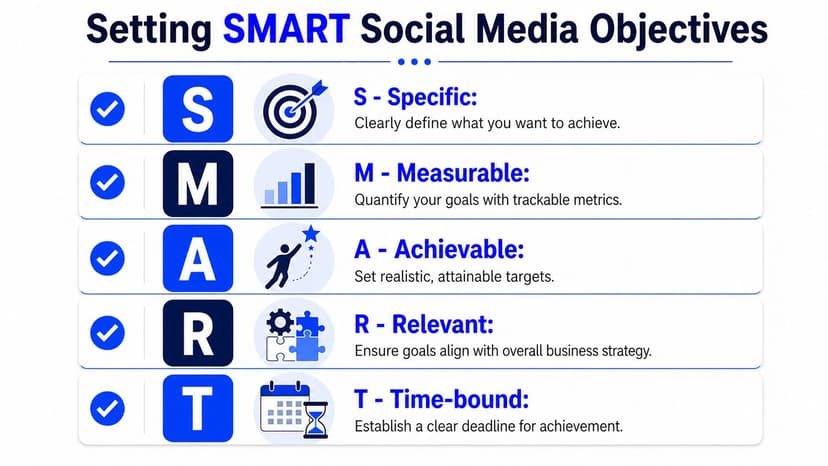
Build the objective in five passes
Start with the client's broad ask. Then tighten it.
Specific
Name the channel, audience, offer, and action. “Get more leads from LinkedIn” is too loose. “Increase qualified leads from LinkedIn lead gen forms” is workable.Measurable
Pick the KPI before you launch. If you can't say exactly what metric proves success, the objective isn't ready.Achievable
Base the target on channel history, budget, and funnel reality. Don't choose a number just because it sounds ambitious in a kickoff meeting.Relevant
Tie the social objective to the client's actual business priority. If sales is the priority, a reporting deck built around reactions and follower growth won't hold up.Time-bound
Set a review window that matches the buying cycle.
Time windows need to match buyer behavior
Agencies often face issues with B2B social. A fixed monthly or 30-day target often makes sense for short-cycle campaigns. It breaks down when the channel is LinkedIn, the audience is senior decision-makers, and the path to conversion is long.
Standard 30-day objective windows fail for B2B clients with 6–9 month sales cycles. Forcing short-term goals on long-funnel channels like LinkedIn is a mistake, with 41% of agencies abandoning high-potential B2B campaigns before the 6-month conversion horizon is reached, based on Social Media Examiner's discussion of strategy timing.
That's why rolling objective windows make more sense for some agency clients. Instead of forcing all social reporting into one monthly success metric, track progress by lifecycle stage.
A practical agency example
Here's a weak objective:
Grow LinkedIn performance this quarter.
Here's a stronger version:
Increase qualified lead volume from LinkedIn form submissions, using a dedicated campaign and tracked landing path, within a review window that matches the client's longer sales cycle.
Notice what changed. The channel is clear. The action is clear. The reporting path is clear. And the timeline fits the client's business instead of your reporting calendar.
SMART works best when it forces agreement before the campaign goes live. That's the point. It removes ambiguity from both strategy and reporting.
Mapping Social Objectives to the Marketing Funnel
Clients get nervous when they see one metric go up and another stay flat. Agencies make that worse when reports don't explain how each metric fits the funnel.
The cleaner way to present social media marketing objectives is to map them to buying stages. That gives every KPI context.
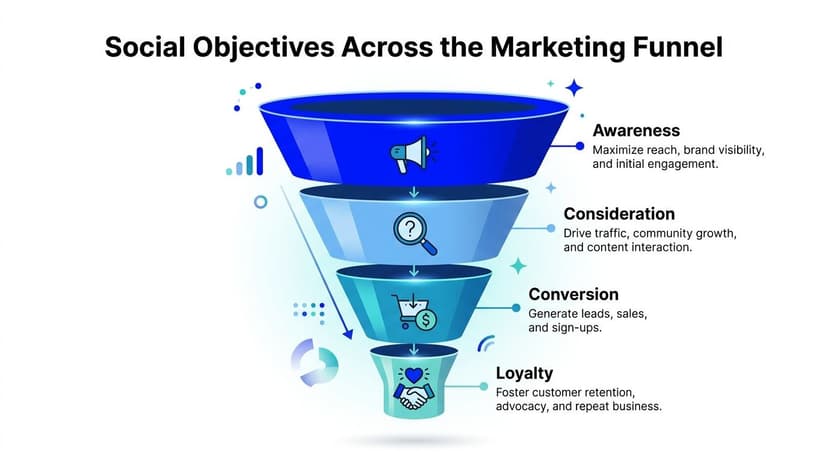
Top, middle, and bottom of funnel
At the top, you're trying to earn attention.
- Awareness uses reach, impressions, and share of voice.
- Consideration uses traffic, engagement quality, and content interaction.
- Conversion focuses on clicks that turn into leads, sign-ups, or sales.
- Loyalty tracks repeat interaction, advocacy, and ongoing customer engagement.
This sounds obvious, but a lot of reports still skip the funnel logic. They mix awareness and revenue metrics without explaining how one supports the other.
For agencies producing content-led campaigns, the role of creative in moving people through these stages matters just as much as the reporting view. Oviond's article on the importance of content in social media marketing is a useful companion to that conversation.
Benchmarks stop bad conclusions
A metric in isolation is dangerous. One of the most common mistakes in client reporting is treating every engagement rate as if the same threshold applies across every platform and campaign type.
Objectives must be set against benchmarks, not absolute numbers. A 0.5% engagement rate on Facebook, for example, is well above the industry median of 0.15%. Agencies should focus on 2-3 key metrics per platform to avoid noise and align them with the goal, according to Brandwatch's social media benchmarking guidance.
That changes how you present results. Instead of saying, “Engagement rate was 0.5%,” say what it means in context.
A short explainer video can help frame that conversation with clients who still expect every platform to behave the same way.
Good reporting doesn't ask whether one number looks big. It asks whether the number is right for the objective and the platform.
That's the shift from dashboarding to client strategy.
Building Reports That Prove Your Agency Is Indispensable
Most client reports fail in the commentary, not the charts. The numbers are there. The agency just doesn't frame them well enough to show judgment.
A useful report doesn't dump metrics and hope the client finds the story. It gives the client a clear interpretation of performance and a reason to keep trusting the team.
Use the three-question structure
Every meaningful metric in a client report should answer:
- What changed
- Why it changed
- What action follows
That isn't just good reporting style. Effective agency reporting must answer those three specific questions for every metric. This framework transforms raw data into financial accountability and prevents vanity metrics from eroding client credibility, as explained by inBeat's marketing agency reporting guidance.
What that looks like in practice
Here's the weak version:
- Engagement increased
- Reach dropped
- Traffic stayed flat
That forces the client to interpret the numbers alone.
Here's the stronger version:
What changed
Engagement increased on short-form educational posts.Why it changed
The creative matched audience interest better than the previous promotional content mix.What action follows
Increase that content type in the next cycle and test a stronger CTA to improve traffic quality.
A client report should read like an account lead thought about the business, not like a coordinator exported a dashboard.
Keep the narrative tied to value
This matters even more when social includes video. If your team is pushing more short-form creative into the mix, it helps to connect performance commentary back to production decisions and expected return. This breakdown on how to achieve high-ROI video content is a useful reference when you need to explain why a format shift matters.
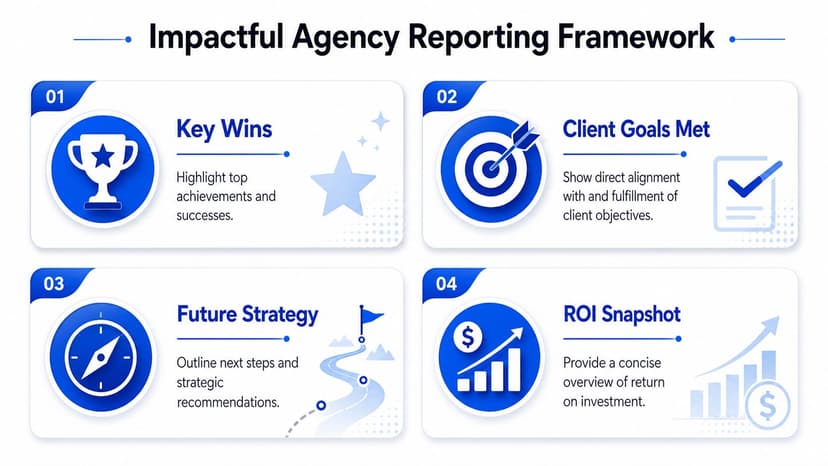
A strong agency report usually includes:
| Report element | What it should do |
|---|---|
| Key wins | Show progress tied to the agreed objective |
| Misses and risks | Show where the objective is off track |
| Commentary | Explain why the numbers moved |
| Next actions | Make the agency's thinking visible |
| ROI snapshot | Connect social performance to business impact when possible |
When reports use this structure consistently, clients stop treating them like a monthly formality. They start treating them like evidence.
Automate Objective Tracking for All Your Clients
Manual reporting breaks first in the ops layer. Not because your team lacks discipline, but because the workflow doesn't scale. Once you're managing a growing client roster, every extra export, spreadsheet tab, and copied chart creates more room for delays and inconsistency.
That's why objective-driven reporting needs an operating system behind it, not just a strategy doc.
What scalable reporting actually requires
To escape manual data fragmentation, agencies must automate their reporting pipeline using integrations and customizable templates. This allows teams to spend saved time generating original insights rather than copy-pasting CSV files from multiple sources, according to Supermetrics on agency client reporting.
That's the baseline. The practical setup usually includes:
- Standard templates for recurring social reports
- Blended data sources so paid, organic, CRM, and site outcomes can be read together
- Branded dashboards for client-facing delivery
- Scheduled sends so the process isn't dependent on who's online that day
- Goal tracking so progress against objectives stays visible all month
If you need a sharper framework for value measurement itself, this social media ROI framework is a useful companion read.
Comparing manual reporting with agency reporting tools
Looker Studio can work, but agencies often outgrow the maintenance. It's flexible, but that flexibility turns into cleanup work when dashboards sprawl across clients and data sources. AgencyAnalytics, Whatagraph, and Swydo are also established options for client reporting, each with their own strengths around templates and presentation.
For agencies that want a simpler, agency-native workflow, Oviond fits the job as white-label client reporting and dashboard software built around recurring multi-client reporting. It includes automated delivery, branded dashboards, custom domain support, unlimited reports, dashboards, and users, plus 70+ integrations and AI/MCP-assisted setup. Its structure is closer to how agencies operate when they need on-brand delivery across many client accounts, without the usual spreadsheet and Looker Studio chaos. If you want a closer look at that workflow, Oviond's page on automated marketing reports shows how scheduled, repeatable reporting is handled.
Keep the stack simple
Marketing agencies typically track only 3–4 core KPIs per client unless the client asks for more, because concise reports focus attention on what matters most and help build stronger client relationships, as noted by Coupler's overview of marketing agency reporting.
That's a useful ceiling for social reporting too. Most clients don't need more charts. They need a stable report, clear commentary, and confidence that the team is tracking the right objective.
Agency reporting that finally feels simple usually comes down to this. Fewer vanity metrics. Cleaner automation. Better client conversations.
If your agency is tired of rebuilding social reports every month, Oviond is worth a look. It gives agencies a white-label way to manage branded dashboards, automated delivery, multi-client reporting, and objective tracking in one place, without turning reporting into another internal project.
Related articles
Simplify marketing reporting today
Stop juggling multiple tools. Start presenting clear, automated reports your clients will love