
Oviond Blog
Top 10 TapClicks Alternative Tools for Agencies in 2026
Searching for a TapClicks alternative? We review 10 agency-focused reporting tools, comparing features, pricing, and white-label options for client dashboards.

It's the last week of the month. Your team is pulling numbers from Google Ads, Meta, LinkedIn, GA4, and whatever CRM a client insisted on using. Someone is still fixing a spreadsheet. Someone else is copying charts into slides. Then you still have to make the report look like it came from your agency, not from five different tools stitched together.
That cycle gets old fast. TapClicks can work, but plenty of agencies hit the same wall. The workflow starts to feel rigid, the setup feels heavier than it should, and the cost can be hard to justify once you're managing recurring reporting across a growing client list.
If you're looking for a TapClicks alternative, keep your standards simple. You need a platform that handles multi-client reporting cleanly, gives you proper white-label delivery, and doesn't create more ops work than it removes. Agency reporting that finally feels simple.
If attribution is also part of the reporting mess you're trying to clean up, Market With Boost's guide to attribution is worth reading alongside this list.
Table of Contents
- 1. Oviond
- 2. AgencyAnalytics
- 3. DashThis
- 4. Whatagraph
- 5. Swydo
- 6. Looker Studio
- 7. Databox
- 8. Klipfolio
- 9. NinjaCat
- 10. Improvado
- Top 10 TapClicks Alternatives, Feature & Pricing Comparison
- Making Your Agency Reporting Finally Feel Simple
1. Oviond
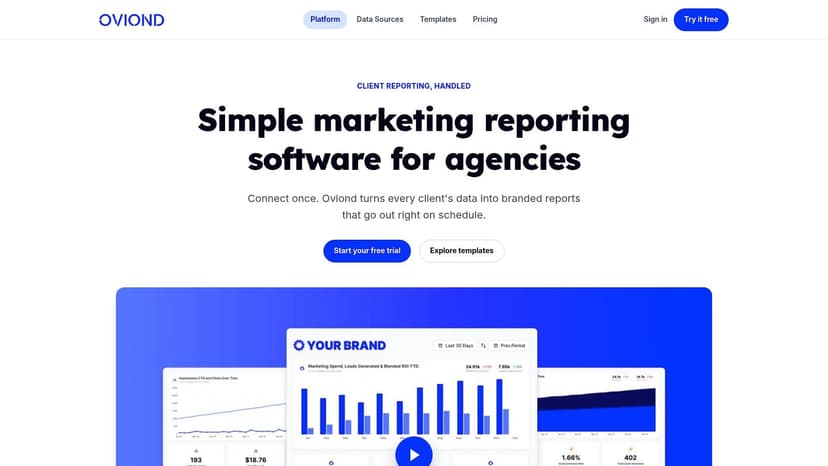
Oviond is the agency-first option on this list. If your reporting process currently lives across spreadsheets, Looker Studio workarounds, and a pile of recurring manual tasks, this is the kind of platform that cleans that up fast. It's built for white-label client reporting and branded dashboards, not for enterprise BI projects dressed up as agency software.
The practical draw is simple. Connect your sources once, build reusable dashboards and reports, and keep client delivery under your own brand. Oviond connects to 60+ marketing data sources including Google Analytics 4, Google Ads, Facebook Ads, LinkedIn Ads, Microsoft Ads, Google Search Console, Mailchimp, and YouTube.
Why Oviond fits agency reporting workflows
Most agencies don't need a reporting stack that takes a technical team to maintain. They need a drag-and-drop builder, templates that speed up setup, calculated metrics, goals, automated delivery, and a clean way to give every client a polished branded experience.
Oviond covers that well. It supports full white-labeling with custom domains and custom email senders, so your reports and dashboards look like they came from your agency. That matters when you're trying to scale trust and consistency across a client roster.
Practical rule: If your reporting tool makes your agency brand feel like an afterthought, it's the wrong tool for client-facing work.
It also gives agencies room to grow without the usual plan friction. According to Oviond's Capterra pricing listing, the platform includes unlimited reports, unlimited live dashboards, and unlimited team users with no per-seat fees, with pricing starting at $49/month monthly or $39/month billed annually.
Where Oviond is strongest
The big differentiator is how the platform is packaged. You're not piecing together white-labeling, automations, API access, and extra user seats as separate upgrades. The model is straightforward and built around client count, which reflects how agencies typically consider scaling.
A few things stand out for busy ops teams:
- White-label delivery: Custom domain, branded dashboards, and custom email sender support keep client reporting under your name.
- No seat anxiety: Unlimited team users means account managers, analysts, and leadership can all get access without a per-user cost discussion.
- Reusable setup: Templates for PPC, GA4, e-commerce, and social reporting help you standardize recurring delivery.
- AI and MCP support: AI-assisted setup and summaries are useful if you want reporting to move beyond static dashboards.
The tradeoff is familiar. A feature-rich platform can take some onboarding, and some connectors may occasionally need reauthorization. That said, for agencies that want an agency-native reporting system instead of reporting sprawl, Oviond is the cleanest fit here.
Visit Oviond.
2. AgencyAnalytics
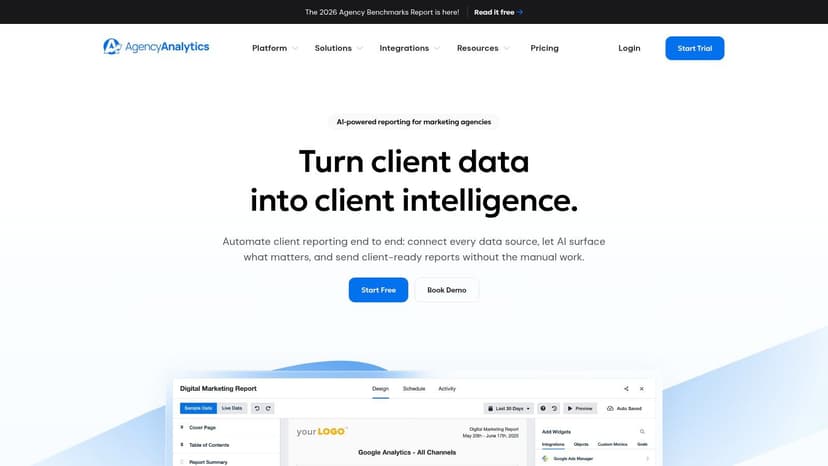
AgencyAnalytics has been aimed squarely at agencies for a long time, and that focus shows. If your team wants a familiar reporting workflow with dashboards, scheduled reports, and solid white-label presentation, it's a credible TapClicks alternative.
It also has meaningful adoption in the agency market. AgencyAnalytics serves over 3,000+ agencies globally and offers 50+ data connections, while TapClicks is positioned with a broader enterprise-heavy connector footprint. That difference matters. Most agencies don't need enterprise sprawl. They need dependable reporting across the channels clients pay for.
Where AgencyAnalytics makes sense
AgencyAnalytics is a good fit when you want a purpose-built agency platform with lower complexity than TapClicks. The same source notes pricing starts at $79/month, which puts it far below the typical TapClicks range cited for similar agency use cases. It also supports unlimited team users, includes API access, and offers prebuilt templates for PPC, social media, and e-commerce reporting in that same source.
That combination works well for agencies managing a moderate client roster and trying to standardize recurring reporting.
- Good choice for agency ops: Drag-and-drop dashboards and scheduled reporting line up with how account teams already work.
- Better for scaling brand consistency: White-label reporting is core to the product, not an afterthought.
- Watch the extras: Some advanced connectors or features can still become add-ons depending on the setup.
If you're comparing the two directly, Oviond vs AgencyAnalytics for agency reporting is worth a look.
Visit AgencyAnalytics.
3. DashThis
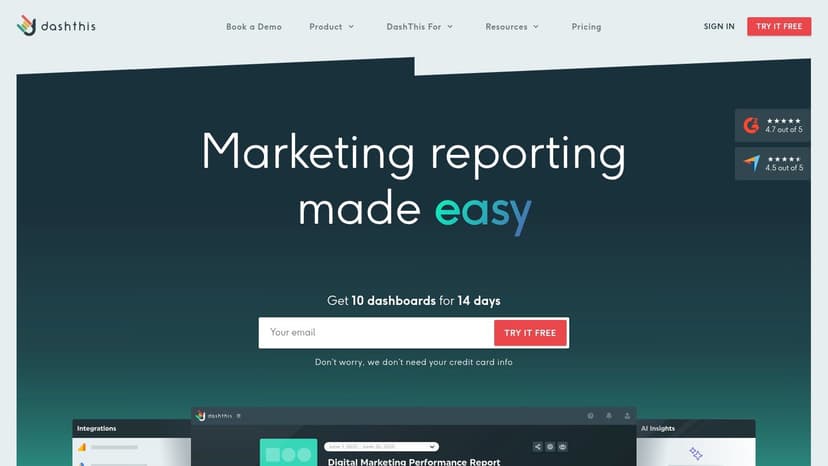
DashThis is for agencies that value speed over deep customization. If your team wants to launch branded dashboards quickly, reuse templates across similar clients, and avoid overbuilding every report from scratch, DashThis makes sense.
Its strength is packaging. The dashboard caps make pricing easier to understand, and the interface is generally geared toward people who need to get reports out without turning reporting setup into its own project.
Best fit for template-first teams
This is the tool I'd put in front of an agency that has a standardized deliverable and wants account managers to build reports without much friction. The preset templates and data blending features make recurring client reporting easier to operationalize.
That said, dashboard-based pricing can start to pinch once client counts rise and reporting gets more segmented by service line, region, or stakeholder group.
Agencies that standardize reporting well usually don't have a dashboard problem. They have a repeatability problem. Tools like DashThis help if repeatability is the bigger issue.
A quick summary:
- Fast to roll out: Good when you want a usable reporting system in place quickly.
- Agency-friendly white-labeling: Custom domain and custom email sender support help keep delivery branded.
- Less ideal for broad source needs: Native integration coverage isn't as wide as some alternatives.
If white-label presentation is a priority, this guide on how to white-label your digital marketing reports and dashboards gives useful context.
Visit DashThis.
4. Whatagraph
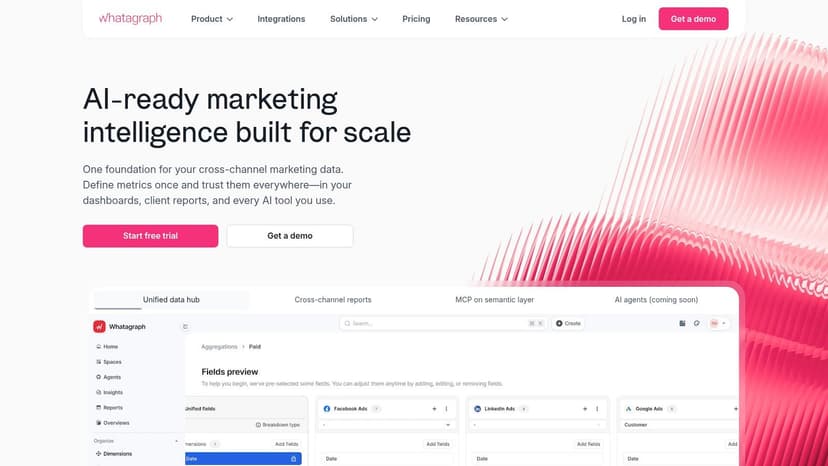
Whatagraph is strong when your agency runs on standardized outputs. If you're delivering recurring channel reports across many similar clients, its templated approach is appealing. Plug in sources, apply your layout, schedule delivery, and keep the process moving.
That makes it a sensible TapClicks alternative for agencies that care more about repeatable client reporting than custom analysis inside the reporting tool itself.
Good for standardized recurring reports
Whatagraph works best in account teams that don't want to reinvent the report every month. It's built around multi-source reporting, white-label delivery, and templated presentation. That's useful if your ops lead is trying to reduce reporting variability across the whole client roster.
The tradeoff is flexibility. If your team regularly needs deeper modeling or custom KPI logic beyond the standard report layer, you may feel constrained sooner than with more customizable platforms.
- Strong for recurring reports: Good fit for agencies with a repeatable monthly or weekly delivery model.
- Branded delivery matters: White-label options support cleaner client-facing presentation.
- Expect a sales conversation: Pricing is often less transparent than tools with clearer self-serve packaging.
Visit Whatagraph.
5. Swydo
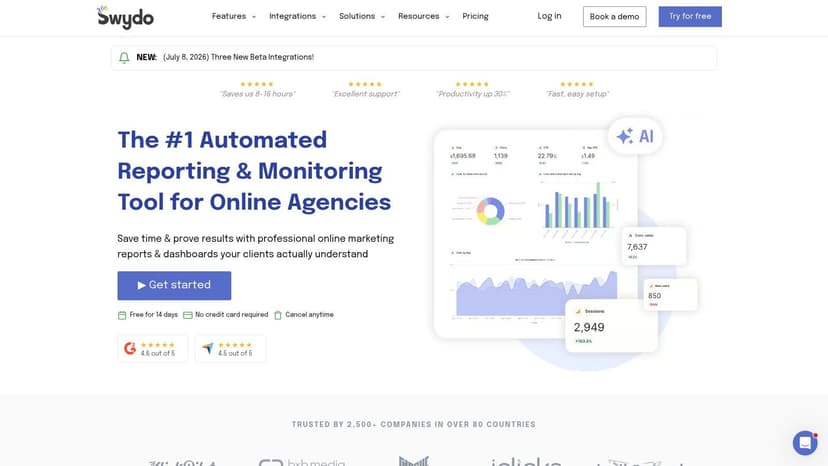
Swydo stays focused. That's why plenty of PPC-heavy agencies like it. It doesn't try to be a giant data platform. It aims to automate report production, keep client access simple, and make recurring channel reporting easier to manage.
For agencies that spend most of their reporting time on paid media, that can be enough.
Strong pick for PPC-heavy agencies
One useful angle from the broader market discussion is cost visibility. The gap in many TapClicks comparison articles isn't just the feature checklist. It's total cost of ownership. The Swydo analysis of TapClicks alternatives points out that agencies often underestimate the full cost of connector-heavy setups, especially when they try to recreate an agency reporting stack with cheaper or free tools plus paid add-ons.
That matters because a reporting system that looks cheap at signup can get messy once you add more channels and more clients.
Swydo is appealing when you want:
- Straightforward report automation: Templates, goal tracking, and scheduled PDF or link delivery.
- Simple access management: Unlimited clients and users on paid plans keeps collaboration easier.
- A leaner reporting tool: Better for PPC and recurring performance updates than complex analytics work.
It won't be the right fit for agencies that need broad data modeling or highly custom dashboards. But if your team wants focused client reporting without a lot of overhead, Swydo is a sensible option.
Visit Swydo.
6. Looker Studio
Looker Studio is the tool agencies keep using because it's flexible and familiar. It's also the tool many agencies eventually outgrow for client reporting. The platform can absolutely work, especially if most of your clients live inside Google's ecosystem, but it pushes more operational work back onto your team than agency-native tools do.
That's the key distinction. Flexibility is not the same as simplicity.
Flexible, but agencies pay elsewhere
Looker Studio is free to use, and that sounds attractive until you start connecting non-Google data. The verified market comparison highlights a common problem: agencies often miss the actual cost of adding third-party connectors, and that can leave their annual reporting budget understated by 30–40%. It also cites paid connector costs such as Supermetrics ranging from $47–$222/month.
That's why Looker Studio often becomes “free plus maintenance plus connector spend plus internal troubleshooting.”
If your ops team is constantly fixing connector issues and versioning dashboards manually, the tool isn't free. You're paying in labor.
Use Looker Studio when your agency has the technical patience to build custom dashboards and maintain them. Skip it if you want built-in white-label workflows, client-friendly delivery, and less reporting chaos.
For a broader roundup, Loooker Studio alternatives for agencies is a useful comparison.
Visit Looker Studio.
7. Databox
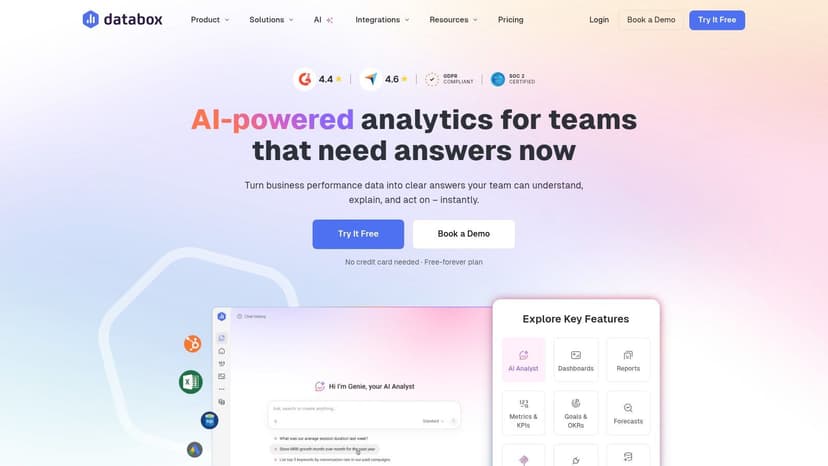
Databox leans more into KPI dashboards than classic client reporting software, but plenty of agencies still consider it because the dashboarding is strong and the template library is mature. If your team wants a central place to monitor account performance and then share curated views outward, Databox can work.
It's a better fit for agencies that think dashboard-first.
Better when you want KPI dashboards first
The upside is breadth. Databox supports lots of integrations, includes AI-oriented features like anomaly detection and forecasting, and offers API access for custom modeling. Agencies that want a more performance-monitoring style workflow often like that setup.
The thing to watch is white-labeling and source packaging. Depending on the plan, some agency-friendly features may sit higher up the pricing ladder or come as extras. For agencies, white-label delivery isn't optional. It's part of the product requirement.
A practical breakdown:
- Good for monitoring: Strong if your team lives in KPI dashboards day to day.
- Useful for larger internal teams: Higher-tier packaging can remove per-seat friction.
- Less clean for pure client reporting: White-label setup may not be as straightforward as tools built around agencies first.
If Databox is on your shortlist, compare it against Databox alternatives for agency reporting.
Visit Databox.
8. Klipfolio
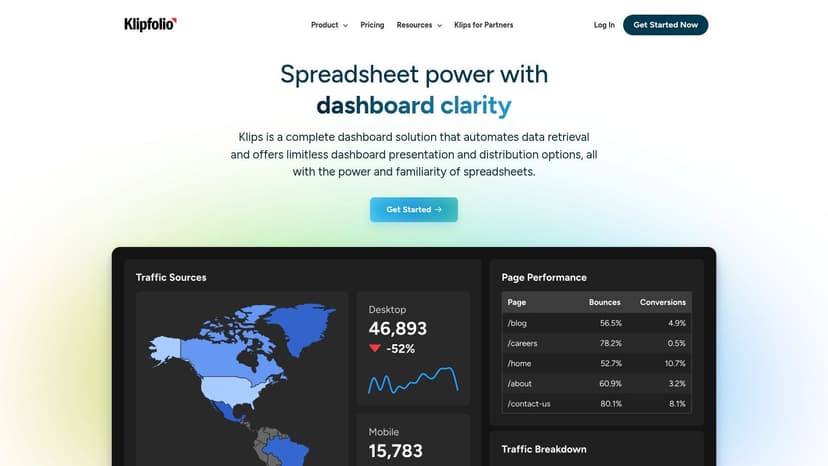
Klipfolio is for agencies that outgrow standard widgets and want more control over how metrics are built. It's less plug-and-play than the template-heavy reporting tools on this list, but it gives you more room to shape data the way you want.
That makes it useful for agencies with unusual KPIs, blended metrics, or reporting requirements that don't fit neatly into canned templates.
Useful when standard widgets are not enough
Klipfolio's spreadsheet-style modeling and deeper customization are the reason to buy it. If your team needs to connect multiple apps, shape metrics across sources, and present custom calculations in dashboards, it has real appeal.
The downside is setup effort. This isn't the easiest option for an agency that just wants branded monthly reports out the door with minimal friction. You'll get more flexibility, but you'll earn it.
- Best for custom KPIs: Strong when templates don't match how your agency reports.
- Good connector coverage: Helpful for diverse source environments.
- Expect more setup: Better for teams comfortable with a more hands-on build process.
Visit Klipfolio.
9. NinjaCat
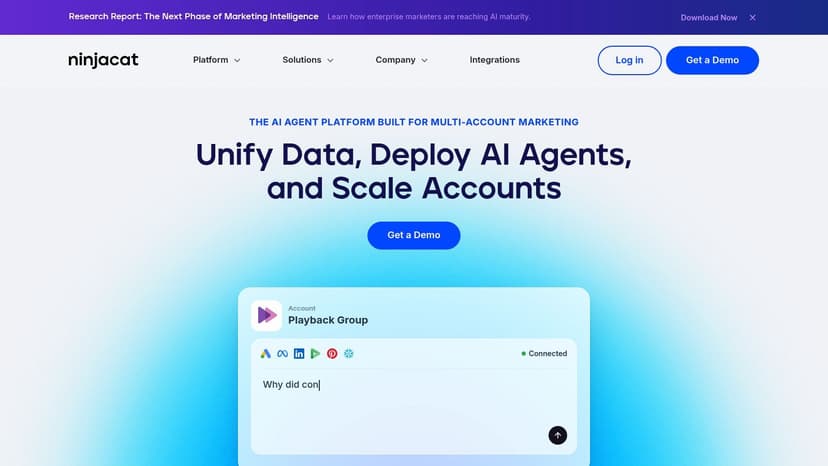
NinjaCat is the heavier-duty agency option on this list. It's aimed at agencies handling volume, multi-location clients, franchise structures, or a lot of repeated white-label reporting across accounts. If your problem is scale and standardization, NinjaCat deserves a look.
It's not the simplest option, but that's not the point of the product.
Built for high-volume white-label reporting
NinjaCat is recognized by G2 as the best overall TapClicks alternative in 2025, and that same source describes it as optimized for multi-client white-label reporting at scale. It also notes white-labeling is standard for plans with 3+ dashboards, with unlimited data sources and integrations across service levels.
That positioning makes sense for large agency teams. NinjaCat puts a lot of weight on always-current data, automated report delivery, and templated reporting workflows across many accounts.
Another important angle is where the market is moving. The Click Intelligence discussion of TapClicks alternatives points to a real gap in current comparisons: AI-driven insight generation still gets treated like a side feature even though agencies are spending 15–20 hours weekly on manual report assembly. That's exactly why static reporting tools are starting to feel dated.
Agencies don't just need dashboards. They need reporting systems that reduce repetitive interpretation work as client count grows.
NinjaCat is a strong choice for larger operations. Smaller agencies may find it more platform than they need.
Visit NinjaCat.
10. Improvado
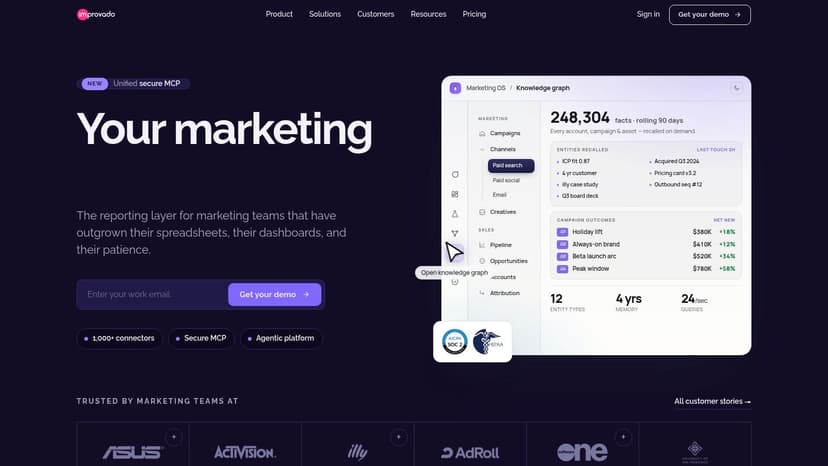
Improvado is here for a different reason than Oviond, Swydo, or AgencyAnalytics. It's less of a straightforward agency reporting platform and more of a marketing data platform. If your agency has moved into complex data governance, warehouse pipelines, or cross-system modeling, Improvado starts to make sense.
If your goal is simple client reporting, it's usually too much.
A data platform more than a reporting tool
Improvado is designed for advanced agencies that care about data ownership, compliance, and more formal data operations. The product is aimed at teams that want to centralize data pipelines and feed dashboards or BI layers with cleaner, governed data.
That can be powerful. It can also create unnecessary complexity for agencies that really just need white-label client reporting and branded dashboards.
A clean way to consider it:
- Choose Improvado if: Your agency has advanced modeling needs, multiple brands or regions, and a stronger technical setup.
- Skip it if: You want an agency-native reporting workflow with fast setup and built-in white-label delivery.
- Expect a strategic rollout: This is closer to infrastructure than a simple reporting app.
For agencies managing 5 to 50+ clients and trying to make recurring reporting easier, most will get more value from a purpose-built reporting tool than from an enterprise-style data platform.
Visit Improvado.
Top 10 TapClicks Alternatives, Feature & Pricing Comparison
| Platform | Core features | UX / Quality | Pricing & Value | Target audience & USP |
|---|---|---|---|---|
| Oviond 🏆 | 60+ connectors, live dashboards, drag‑and‑drop reports, calculated metrics, API ✨ | ★★★★★, unlimited dashboards & users; AI summaries; migration & human support | 💰 From $39/mo (ann., up to 5 clients); single plan, scales by client | 👥 Agencies, full white‑label, automated scheduling, MCP AI assistants ✨ |
| AgencyAnalytics | 85+ integrations, live dashboards, white‑label, AI summaries | ★★★★, mature templates; unlimited staff & client logins | 💰 Simple per‑client pricing; most features included | 👥 Agencies, easy per‑client billing, agency templates ✨ |
| DashThis | Preset templates, data blending, white‑label, unlimited users | ★★★★, fast setup; template-driven | 💰 Priced by dashboard count, predictable packaging | 👥 Teams wanting quick implementation, ready templates & blending ✨ |
| Whatagraph | Automated multi‑source reports, templated layouts, scheduled delivery | ★★★, plug‑and‑send for recurring reports | 💰 Tiered by data sources; pricing may require sales call | 👥 Agencies standardizing repeatable reports, fast templated outputs ✨ |
| Swydo | PPC-centric automation, templates, goal tracking, PDF/link delivery | ★★★, simple, focused PPC reporting | 💰 Flat fee + data source bundles; scalable for agencies | 👥 PPC-heavy agencies, straightforward scaling, unlimited clients/users ✨ |
| Looker Studio | Free, native Google integrations, highly customizable, many connectors | ★★★, very flexible but technical; DIY setup | 💰 Free to use; third‑party connector costs may apply | 👥 Technical teams/agencies, fully bespoke dashboards ✨ |
| Databox | 130+ integrations, AI analyst, forecasting, sub‑accounts | ★★★★, BI-like controls; forecasting & anomaly detection | 💰 Paid tiers; white‑label on higher plans; some per‑source costs | 👥 Teams wanting BI features without per‑seat fees, AI analyst ✨ |
| Klipfolio | Hundreds of connectors, spreadsheet-style modeling, deep metric customization | ★★★, powerful but requires setup/skills | 💰 Tiered pricing; investment in config time | 👥 Agencies needing advanced data shaping, custom metrics & modeling ✨ |
| NinjaCat | Automated templated reporting, Data Cloud, AI alerts, multi‑account scale | ★★★★, enterprise-grade automation & governance | 💰 Quote-based enterprise pricing | 👥 Large agencies / multi-location brands, governed data layer & scale ✨ |
| Improvado | 800+ integrations, ETL/ELT pipelines, data governance & compliance | ★★★★, enterprise ETL + dashboarding | 💰 Enterprise pricing; higher cost | 👥 Enterprise agencies, data ownership, compliance (SOC2, HIPAA, GDPR) ✨ |
Making Your Agency Reporting Finally Feel Simple
Switching away from TapClicks isn't about chasing a longer feature list. It's about getting your reporting workflow under control. If your team still spends the end of every month pulling data manually, cleaning up exports, rebuilding the same layouts, and trying to make reports look on-brand, the problem isn't effort. The problem is the system.
For agencies managing 5 to 50+ clients, the right TapClicks alternative should do a few things well. It should pull your channel data into one place. It should support white-label client reporting without extra gymnastics. It should make automated delivery normal, not something you bolt on later. And it should scale in a way that still makes sense when your client roster grows.
That's why the tools on this list split into a few clear categories.
Some are purpose-built agency reporting platforms. Oviond, AgencyAnalytics, Whatagraph, Swydo, DashThis, and NinjaCat sit in that lane, though they differ in complexity and fit. Some are dashboard-heavy platforms that can work for agencies but may need more thought around white-labeling or plan structure, like Databox and Klipfolio. Then there's Looker Studio, which is flexible but often creates hidden reporting ops work. And Improvado sits in a different category entirely, better suited to agencies with more advanced data infrastructure needs.
If your agency wants the simplest path to branded multi-client reporting, don't overcomplicate the decision. Start with tools that were designed for agency workflows. That means reusable templates, branded dashboards, custom domain support, automated delivery, and pricing that scales by client count instead of creating friction every time you add a teammate or a dashboard.
Oviond stands out on that front. It's built specifically for agency reporting and dashboard delivery, not adapted from a broader BI product. It gives agencies a single-plan approach, pricing by client count, unlimited dashboards, unlimited reports, unlimited users, white-label delivery, custom domain support, and a setup model that matches how agency teams work. It also keeps the workflow grounded in practical reporting tasks. Pull in your analytics, paid media, search, social, email, CRM, and e-commerce data. Build the report once. Reuse what works. Deliver it under your brand.
That matters because growth exposes reporting weakness fast. What feels manageable with a handful of clients becomes messy when you're handling monthly delivery across dozens of accounts. Spreadsheets multiply. Looker Studio setups drift. Branding becomes inconsistent. Reporting QA starts eating time your team should spend on strategy and client service.
Agency reporting that finally feels simple isn't a slogan. It's the operational standard you should expect from your reporting platform.
If you need a comprehensive, agency-native platform with a single plan that includes unlimited dashboards, reports, and users, strong white-labeling, and predictable per-client pricing, Oviond is the most practical choice on this list. It's designed to make client reporting feel simpler, more scalable, and more professional without pushing your team into enterprise complexity they don't need.
If you want white-label client reporting and branded dashboards without spreadsheet chaos, take a closer look at Oviond. It's built for agencies that need multi-client reporting to stay clean, scalable, and on-brand as they grow.
Related articles
Simplify marketing reporting today
Stop juggling multiple tools. Start presenting clear, automated reports your clients will love