
Oviond Blog
10 DashThis Competitors for Marketing Agencies
Compare 10 DashThis competitors for agencies across integrations, white-labeling, automation, pricing, team access, and client reporting use cases.

The monthly reporting cycle starts with a familiar mess. An account manager pulls numbers from Google Ads, Meta, GA4, LinkedIn, email, and e-commerce platforms, then rebuilds a report that looks slightly different from the last one. Metrics need checking, client branding needs fixing, and the final update still feels more like a data dump than a useful conversation.
That workflow becomes harder as your agency moves from a few accounts to 5–50+ clients. A reporting tool has to do more than display charts. It needs to collect scattered data, standardize reusable dashboards, deliver branded reports automatically, and give your team access without adding seat, source, dashboard, or white-label charges.
This list of DashThis competitors focuses on those practical decisions. Each platform is judged against the recurring agency workflow, including connector coverage, white-label delivery, automation, pricing structure, team access, data flexibility, and migration effort. Oviond is the featured agency-first option, while AgencyAnalytics, Whatagraph, Swydo, Looker Studio, and the other alternatives receive a balanced assessment.
Table of Contents
- 1. Oviond
- 2. AgencyAnalytics
- 3. Databox
- 4. Whatagraph
- 5. Klipfolio
- 6. NinjaCat
- 7. Swydo
- 8. ReportGarden
- 9. TapClicks
- 10. Looker Studio and Looker Studio Pro
- DashThis Competitors, Top 10 Comparison
- Choose the Reporting Stack Your Agency Can Repeat
1. Oviond
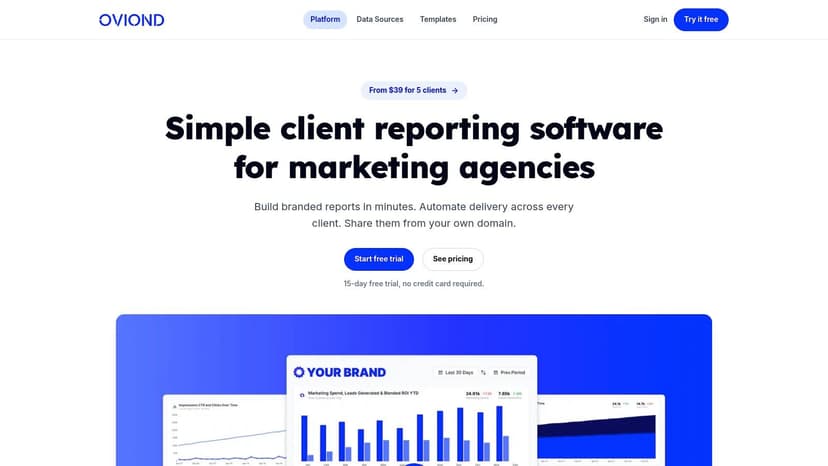
Oviond is built around the reporting process agencies repeat for every client. It brings analytics, paid media, search, social, email, CRM, and e-commerce data into live dashboards and scheduled branded reports, so account managers aren't rebuilding the same reporting logic in spreadsheets or disconnected Looker Studio files.
The platform connects 60+ data sources, including Google Analytics 4, Google Ads, Meta, LinkedIn, Shopify, Mailchimp, and YouTube. Its drag-and-drop editor supports reusable templates, calculated metrics, goals, custom queries, Google Sheets imports, and blended metrics. Agencies can create a PPC report once, adapt it for each account, and deliver it through a branded dashboard, email, link, or embed.
Why agencies choose Oviond
Oviond puts white-label delivery, custom domains, custom email senders, unlimited dashboards, unlimited reports, unlimited team users, and API access into one plan. Pricing scales by client count rather than seats or source credits, starting at $39 per month when billed annually for up to five clients, or $49 month to month. Those prices and plan details come from the provided publisher information.
That structure matters when your team grows. You can invite account managers, client-success staff, and leadership without calculating another seat fee, while reusable assets prevent every new client from becoming a fresh production project. Oviond also includes AI-assisted setup through an MCP server, allowing agencies to connect assistants such as Claude or ChatGPT for prompt-driven report creation and insight generation.
- Agency-native workflow: Templates, automations, scheduled delivery, goals, calculated metrics, and client branding sit in one reporting process.
- Scaling access: Unlimited users, dashboards, and reports support broad internal and client access without per-seat friction.
- Hands-on onboarding: Human support and migration assistance are available from the smallest plan.
- What to validate: Advanced customization can take setup time, and agencies should test niche connectors, PDF behavior, and complex blended metrics during the trial.
Oviond says it's used by 3,000+ agencies and reports a rating of approximately 4.3 out of 5 on Capterra, based on the publisher information supplied for this comparison. A 15-day free trial with no credit card gives you a practical way to rebuild one real client dashboard before moving your full reporting operation.
Practical rule: Don't evaluate Oviond with a blank demo account. Connect one difficult client, recreate the recurring report, configure the branding, and test the scheduled delivery.
2. AgencyAnalytics
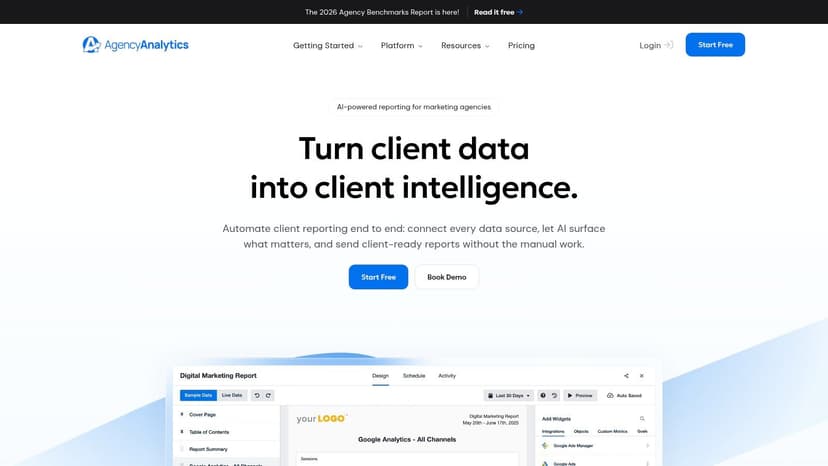
AgencyAnalytics is one of the closest direct DashThis competitors for agencies that want client reporting, white-label dashboards, scheduled delivery, and client-facing workflows in one place. The platform offers 85+ integrations, unlimited staff and client users, and client-based pricing in its Core plan, according to a 2026 comparison of DashThis alternatives.
Its agency workflow includes templated and drag-and-drop report builders, client login portals, approvals, roll-ups, goals, alerts, forecasting, anomaly detection, and AI-assisted insights. That makes it a strong fit for account managers who need more than a monthly PDF, especially when clients want a portal they can revisit between meetings.
Where it fits
AgencyAnalytics stands out when your agency also needs built-in SEO auditing and client workflow features. Its white-label setup supports custom domains and custom email senders, so the client experience can stay under your brand rather than exposing the reporting vendor.
The pricing model is easier to forecast than seat-based software because it follows the number of clients rather than the number of staff members. The trade-off is that database connectors are an add-on, and advanced SEO functions such as rank tracking can cost extra. That matters if your agency wants every reporting capability included in one predictable plan.
- Strong choice for: Agencies that want mature white-labeling, client portals, SEO reporting, and unlimited internal and client users.
- Watch the scope: Confirm which SEO and database capabilities are included in your selected plan.
- Compare carefully: AgencyAnalytics is broad and established, while Oviond puts its emphasis on a single agency reporting plan with migration help and client-count pricing.
Agencies comparing total cost should model the platform using the number of active clients, required SEO tools, database needs, and branding requirements. The headline price matters less than whether the features you use every month are included.
For a closer pricing-focused comparison, review AgencyAnalytics pricing compared with Oviond.
3. Databox
Databox takes a KPI-first approach. It combines dashboards with goals, OKR workflows, forecasting, alerts, automated summaries, and an AI analyst called Genie. For agency teams that need to show whether a client is moving toward defined targets, that focus can be more useful than a dashboard filled with disconnected channel widgets.
The platform supports 130+ native integrations, along with API, spreadsheet, database, and dataset connectors. Its agency setup includes sub-accounts for separating clients, while higher plans provide unlimited dashboards, reports, and users. The supplied product notes also identify frequent synchronization options, including refreshes of up to 15 minutes on the Growth plan, as a plan-specific feature.
The agency trade-off
Databox gives teams meaningful flexibility in data preparation. Datasets can help organize source data before it reaches a dashboard, and Genie can produce performance summaries and flag anomalies. That combination works well when account managers need a quick explanation of movement rather than another chart to interpret.
White-labeling is the main commercial consideration. It's available as an add-on or through a Custom plan, and entry plans limit data sources while extra sources can create incremental costs. For an agency managing many clients across paid media, analytics, CRM, and commerce, those limits can make a seemingly simple setup harder to forecast.
- Choose Databox for: Goal tracking, AI-assisted summaries, flexible datasets, and broad connectivity.
- Be careful with: Source limits and the cost of adding complete white-label delivery.
- Test with: A client that needs blended data, several sources, and branded delivery, not just a single KPI dashboard.
Oviond makes a different decision by including white-label features, unlimited users, dashboards, and reports in its agency plan, with pricing based on client count. Databox is stronger when KPI management and data preparation lead the workflow, while Oviond is more direct for agencies that primarily need repeatable, branded client reporting.
The Databox alternative comparison from Oviond is useful when you're weighing those workflow differences.
4. Whatagraph
Whatagraph is designed for agencies that need consistent, repeatable reports across many accounts. It combines multi-channel data, reusable dashboards and decks, templates, automated delivery, and white-label client presentation. A 2026 comparison from Whatagraph describes the platform as part of the broader move toward automation, cross-channel unification, and AI-assisted agency workflows.
A separate DashThis alternatives roundup places Whatagraph among the major options in this category and describes a model that blends 40+ data sources with source groups that can combine multiple advertising accounts into one metric. Its annual Go plan starts at €199 per month, according to the supplied 2026 comparison data.
Why standardization matters
Whatagraph's strongest agency benefit is consistency. Teams can establish shared KPI definitions, build reusable dashboards or decks, and deliver a similar reporting experience across clients without recreating every visual from scratch. That's valuable when several account managers need to follow the same reporting standard.
The trade-off is commercial visibility. Pricing details are gated and require a sales conversation, so you'll need to confirm how the platform behaves with your actual client count, source mix, reporting volume, and branding requirements. The native integration catalog may also be smaller than some broader data or enterprise suites.
- Good fit for: Agencies that prioritize reusable client decks, standardized metrics, and polished multi-channel presentation.
- Main question: Can the platform support your less common client sources without manual workarounds?
- Compare against Oviond: Oviond offers a single plan with client-count pricing, unlimited reports and dashboards, white-label delivery, custom domains, custom senders, and migration assistance.
The bigger category shift is from designing attractive dashboards to maintaining dependable reporting systems. Your team should test how quickly a new client can inherit an approved template, how edits flow across reusable assets, and how much effort is required when a connector or KPI definition changes.
For a direct alternative review, see Oviond compared with Whatagraph.
5. Klipfolio
Klipfolio is the customization-heavy option in this list. It supports 130+ integrations, API and REST or URL connectors, data modeling, joins, scheduled reports, PDF exports, published links, and frequent refresh intervals that can reach up to the minute on higher plans, according to the supplied product notes.
That flexibility suits agencies with unusual data structures or clients who need reporting logic beyond standard marketing templates. A technically confident operations lead can combine sources, model data, and tune visualizations at a granular level instead of accepting a fixed widget library.
More control means more setup
Klipfolio's strength can also become the cost. The platform has a steeper learning curve than template-led reporting tools, particularly when your team needs to build complex data preparation rules rather than assemble familiar campaign charts. Account managers can produce excellent reports, but they may need more training and documentation before they can work independently.
Full rebranding requires the optional White-Label Bundle, which adds another pricing decision for agencies that need a vendor-free client experience. Confirm whether the bundle includes the custom theme, custom domain, and branding controls you expect before comparing the headline subscription.
- Choose Klipfolio when: Data modeling and fine-grained visualization control matter more than fast template deployment.
- Avoid feature-list noise: More connector depth doesn't automatically reduce maintenance. Test the actual joins and calculations your client reports require.
- Consider Oviond when: Your team wants reusable agency templates, white-label delivery, unlimited users, and client-count pricing in one plan.
Klipfolio is a credible choice for an agency with a technically capable reporting function. It's less attractive when the main problem is account managers spending too much time rebuilding recurring reports and chasing brand consistency.
The Oviond versus Klipfolio comparison can help you evaluate control against setup effort.
6. NinjaCat
NinjaCat is designed for agencies and multi-account marketers operating at a larger scale. Its platform combines marketing data ingestion, normalization, automated report assembly, scheduled distribution, and AI agent workflows for monitoring, anomaly detection, budget pacing, and optimization. It also offers optional call tracking through NinjaTrack.
The key distinction is operational depth. NinjaCat isn't merely a dashboard editor. It aims to organize the pipelines and reporting processes behind many accounts, including franchises and complex multi-location operations. That makes it relevant when reporting failures come from data movement, account volume, and governance rather than the appearance of a client dashboard.
Who should use it
NinjaCat is a better fit for large agencies managing hundreds of accounts or franchise reporting structures. Its enterprise orientation gives operations teams room to build extensive automation and normalization processes, but that strength comes with a custom pricing model and a heavier buying process than SMB-focused tools.
For a smaller agency, that can be unnecessary overhead. If your team manages recurring reports for a manageable roster and mainly needs branded dashboards, automated delivery, reusable templates, and broad team access, a simpler platform may get you to a finished client report with less implementation work.
- Best suited to: Large agencies, franchises, and multi-account operations with demanding data workflows.
- Operational advantage: Strong data harmonization and automation across many accounts.
- Primary drawback: Custom enterprise pricing and breadth that may exceed the needs of a smaller agency.
Oviond targets the agency reporting layer more directly. It offers template-driven setup, white-label dashboards, scheduled delivery, custom domains, custom email senders, unlimited reports and dashboards, AI or MCP-assisted creation, and human migration support from its smallest plan.
If the team is still exporting data manually, don't buy enterprise data operations before testing a repeatable reporting template.
7. Swydo
Swydo keeps its agency workflow straightforward. It offers unlimited clients, users, dashboards, and reports, with white-labeling, templates, live dashboards, Google Sheets imports, goals, alerts, automated scheduling, and AI-powered report summaries.
Its pricing is tied to data sources, which can be easier to understand for clients with compact channel stacks. Swydo supports 32+ integrations, including combined advertising data sources and custom metrics, according to the supplied plan notes. That makes it a practical option for agencies that mostly report on core advertising and analytics channels.
Source-based pricing needs a real client test
The source model is predictable only when you know how many accounts each client uses. Google Ads, Meta, GA4, LinkedIn, and Search Console can quickly create a broader source footprint than the dashboard itself suggests. Agencies should count connected accounts, not just platform categories, before approving the budget.
Swydo also provides hands-on human support, onboarding, and migration help. That's a meaningful advantage for an agency moving away from spreadsheets or another dashboard system. The limitation is connector breadth. Complex blends involving many non-advertising sources may require Google Sheets or API workarounds.
- Use Swydo for: Simple, automated, white-label reports with source-based cost control.
- Check first: Every client's connected account count and any niche source requirements.
- Choose Oviond instead when: You want client-count pricing, 50+ connections, unlimited assets and users, full white-labeling, and AI or MCP-assisted setup in one plan.
Swydo is easy to recommend for smaller, focused reporting stacks. It becomes less compelling when your agency supports varied client ecosystems and wants to avoid source-by-source cost calculations.
8. ReportGarden
ReportGarden combines client reporting with operational features that many agencies manage elsewhere. Alongside dashboards, templates, automated reports, and integrations for Google and Meta advertising and GA4, it includes budget tracking, invoicing, a light CRM, and an SEO suite with rank monitoring.
That combination makes ReportGarden different from a pure dashboard competitor. If your account team wants reporting and basic commercial operations in the same workspace, consolidating those tasks can reduce the number of tools they open during a client cycle.
Reporting plus agency operations
The advantage is practical rather than visual. An agency can connect performance reporting with budgets and invoices, which may help account managers keep delivery and commercial details in the same workflow. The help center and onboarding resources also support teams that need guidance while building repeatable processes.
The trade-off is product depth. User experience and connector coverage may not match larger reporting platforms, and pricing transparency can vary, sometimes requiring a sales conversation or in-app review. Those details matter when you're comparing ReportGarden with a dedicated white-label reporting platform.
- Choose ReportGarden when: Budget tracking, invoicing, SEO, and reporting need to live together.
- Check the workflow: Confirm that the reporting editor and connectors match the standards your account managers already use.
- Choose Oviond when: Your priority is branded, always-current client reporting with unlimited dashboards, reports, users, scheduled delivery, and custom domain support.
ReportGarden makes sense when operational consolidation is the deciding factor. It isn't the obvious choice for an agency whose main problem is scattered marketing data and inconsistent client-facing report delivery.
9. TapClicks
TapClicks is aimed at marketing operations, agencies, media companies, multi-brand organizations, and franchise networks that need broad ingestion and roll-up reporting. It offers 200+ instant-on connectors, SmartConnector for custom or long-tail sources, automated scheduling, cross-account blends, rollups, and SmartAnalytics with natural-language dashboard questions, according to the supplied product notes.
The platform's value appears when reporting architecture is the hard part. A team can combine many accounts, locations, brands, and sources into structured reporting workflows rather than managing every client dashboard as an isolated asset.
Enterprise breadth comes with implementation work
TapClicks is a strong fit for agencies handling multi-location or multi-brand reporting. Its connector breadth reduces the chance that an unusual source will force a manual export, while SmartConnector provides a route for custom data. Automated scheduling and rollups support senior reporting views as well as client-level outputs.
The cost is complexity. Pricing is quote-based and typically enterprise-level, and the breadth of features creates a higher learning curve. A small agency that needs branded dashboards for a growing client roster may spend more time configuring the platform than improving the actual reporting process.
- Best for: Large agencies, franchises, and multi-brand operations with complex rollups.
- Main advantage: Extensive connectivity and flexible data ingestion.
- Main risk: Enterprise setup, pricing, and administration may be excessive for straightforward client reporting.
Oviond is more suitable when you want a simpler agency-native process. It focuses on reusable dashboards, branded delivery, automated reporting, client-count pricing, unlimited users and assets, and AI or MCP-assisted setup without requiring your team to adopt a broad marketing-operations suite.
10. Looker Studio and Looker Studio Pro
Looker Studio remains the most flexible low-cost starting point for agencies comfortable building their own reporting system. The core product is free to start and supports interactive, shareable dashboards through built-in and partner connectors. Looker Studio Pro adds team workspaces, organization-owned content, administration and IAM controls, and Google Cloud Customer Care.
For an agency already invested in Google Analytics, Google Ads, Google Sheets, and partner connectors, that ecosystem can feel familiar. Account managers can share dashboards, customize layouts, and create calculated fields. Optional Gemini assistance can help with calculated fields and insights, while mobile access supports dashboard viewing away from a desktop.
Free doesn't mean simple
Looker Studio's core cost advantage can hide the operational burden. Your team still needs to configure connectors, maintain templates, manage client permissions, document calculated metrics, and troubleshoot broken data sources. A complex multi-client white-label experience requires extra setup and connectors, and governance or support features require Pro alongside a Google Cloud support plan.
That's why Looker Studio often becomes “chaos” rather than a repeatable agency system. One account manager may build a report differently from another, and every client variation can create another file to maintain.
- Choose Looker Studio for: Agencies with strong Google expertise, modest branding requirements, and the time to maintain their own reporting framework.
- Choose Pro for: Organization-owned assets, team workspaces, administrative controls, and paid support requirements.
- Choose Oviond for: A managed agency reporting workflow with templates, white-label delivery, automation, custom domains, custom senders, unlimited users, dashboards, and reports.
Looker Studio is a capable building block. Oviond is the more direct replacement when your agency wants reporting that finally feels simple.
DashThis Competitors, Top 10 Comparison
| Product | Core features | Quality ★ | Price/Value 💰 | Target 👥 | Unique ✨ |
|---|---|---|---|---|---|
| Oviond 🏆 | 60+ connectors, live dashboards, drag‑drop builder, white‑label, AI, unlimited reports | ★★★★☆ (4.3) | Starts $39/mo (annual), scales by clients 💰 | Agencies, in‑house teams | ✨Single all‑features plan, unlimited users, MCP AI & migration help |
| AgencyAnalytics | 85+ integrations, templated builder, client portal, white‑label | ★★★★☆ | Client‑based pricing; unlimited dashboards on main plans 💰 | Agencies with client workflows | ✨Client approvals, forecasting, mature white‑label |
| Databox | 130+ integrations, datasets, Genie AI, anomaly detection | ★★★★☆ | Mid, Pro+ adds unlimited users; WL add‑on 💰 | Growth teams & agencies | ✨Genie AI analyst, frequent syncs & datasets |
| Whatagraph | Prebuilt templates, unified KPI defs, automated delivery, white‑label | ★★★★ | Sales‑quoted / mid‑range 💰 | Agencies needing consistent KPI decks | ✨Standardized KPI definitions across outputs |
| Klipfolio | 130+ connectors, data modeling/joins, dev connectors, frequent refresh | ★★★★ | Flexible plans; white‑label bundle add‑on 💰 | Data-savvy teams & devs | ✨Advanced data prep & custom joins |
| NinjaCat | Data pipelines/harmonization, templated automation, AI agents, call tracking | ★★★★ | Enterprise pricing (quote) 💰 | Large agencies, franchises | ✨Enterprise pipelines + NinjaTrack call tracking |
| Swydo | Unlimited clients/users, templates, goals/alerts, AI summaries | ★★★ | Per‑data‑source pricing (predictable) 💰 | Small/mid agencies on budget | ✨Transparent per‑source pricing + hands‑on onboarding |
| ReportGarden | Reports + dashboards + budgeting, invoicing & SEO tools | ★★★ | Varies / sales‑gated 💰 | Agencies wanting reporting + ops | ✨Budgeting & invoicing built into reporting |
| TapClicks | 200+ connectors, SmartConnector, rollups, SmartAnalytics (LLM chat) | ★★★★ | Enterprise / quote (higher) 💰 | Multi‑brand enterprises & media cos | ✨Massive connector library & franchise rollups |
| Looker Studio (Pro) | Interactive dashboards, partner connectors; Pro adds governance & org controls | ★★★★ | Free core; Pro enterprise pricing 💰 | Broad (freelancers → enterprises) | ✨Free to start + vast partner ecosystem and Pro governance |
Choose the Reporting Stack Your Agency Can Repeat
The right DashThis competitor depends on the work your agency needs to repeat, not the platform with the longest feature list.
Choose Oviond when your priority is simple, branded client reporting across multiple channels. Its agency-native model combines client-count pricing, unlimited dashboards, unlimited reports, unlimited users, white-label delivery, custom domains, custom email senders, automation, migration help, and AI or MCP-assisted setup. It's designed to replace spreadsheet-heavy reporting and disconnected Looker Studio files with reusable assets and a consistent client experience.
Choose AgencyAnalytics when you want mature client portals, SEO tools, broad integrations, and unlimited staff and client users. Choose Whatagraph when standardized KPIs, reusable decks, and multi-account aggregation are central to your delivery process. Databox is a better fit for goal tracking, AI summaries, and flexible datasets, while Klipfolio suits teams that need deeper data modeling and visualization control.
Swydo works for agencies with a focused source mix and a preference for source-based pricing. ReportGarden adds budget, invoicing, CRM, and SEO workflows. NinjaCat and TapClicks are aimed at larger operations that need extensive ingestion, normalization, rollups, and multi-account governance. Looker Studio remains useful when your team accepts the setup and maintenance responsibility in exchange for a free-to-start tool.
Before switching, follow a controlled migration process:
- Inventory every client asset: List each dashboard, recurring report, delivery schedule, recipient, client permission, and branded URL.
- Map data sources: Record every platform, account, property, spreadsheet, custom import, and calculated metric used by each client.
- Document KPI definitions: Write down formulas for metrics such as leads, cost per lead, return on ad spend, revenue, and conversion rate so the new report doesn't alter the meaning.
- Rebuild one reusable template: Start with a representative client that uses several channels and has real branding requirements.
- Configure delivery and branding: Set up logos, colors, custom domains, custom email senders, report links, embeds, and scheduled delivery.
- Test access and refreshes: Check account-manager permissions, client visibility, data refresh behavior, calculated metrics, goals, blended sources, and exports.
- Run reports in parallel: Compare old and new outputs through a complete reporting cycle before retiring the existing workflow.
- Confirm client-facing links: Verify every domain, email sender, permission, and dashboard link before changing the delivery process.
The practical decision is simple. If your agency is mainly solving enterprise ingestion, TapClicks or NinjaCat may justify the added complexity. If it needs developer-level modeling, Klipfolio can provide more control. If it needs a low-cost Google-based system and has the capacity to maintain it, Looker Studio remains viable. If the agency wants one repeatable reporting process for 5–50+ clients, Oviond is the clearest recommendation.
Start with a real migration, not a feature tour. Connect the client sources you use most, recreate a reusable dashboard, test your branding and delivery, and ask your account managers whether the workflow is easier to maintain. If your agency needs specialist implementation or broader marketing operations advice, consider working with a marketing consultant after you've documented the reporting process you want to standardize.
Oviond brings multi-source client reporting, reusable dashboards, automated delivery, full white-labeling, custom domains, custom email senders, unlimited users, and AI or MCP-assisted setup into one agency-focused plan. Visit Oviond to connect a real client account, test your reporting template, and see whether it can replace the monthly spreadsheet and dashboard scramble.
Related articles
Simplify marketing reporting today
Stop juggling multiple tools. Start presenting clear, automated reports your clients will love